
- Chennai
- Tamil Nadu
- India
- World
- EntertainmentEntertainment
- Business
- Sports
- Lifestyle
- Technology
- Videos
- Explainers
- Editor's Picks
The horrific explosion at a firecracker unit in Virudhunagar district on Sunday (April 19), in which 23 workers were killed, shatters the public’s confidence in the safety regime applied to hazardous industries, particularly firecracker manufacturers in Tamil Nadu. The occurrence in the past three months of three such tragedies at disparate locations Bhiwadi, Rajasthan; Kakinada, Andhra Pradesh; Virudhunagar, Tamil Nadu calls for an immediate and comprehensive safety audit of such industries, going further than arrests and other showcase action.

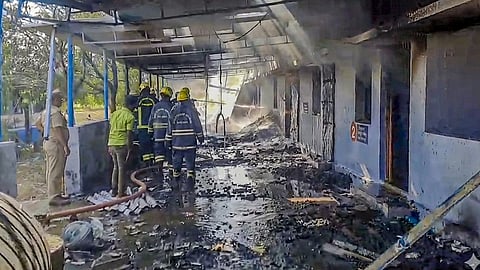
The explosion at a fireworks unit in Kattanarpatti village in Virudhunagar district on Sunday afternoon took place when more than 40 workers were handling explosive raw materials in the front veranda of the premises. The blast reduced the four-room factory to rubble and levelled some adjacent structures as well. In addition to the 23 deaths, at least 11 workers have been gravely injured, some with 80% burns.
Several facts point to lax adherence to safety regulations in this incident the likes of which are tragically all too common in cracker manufacturing hubs across India.
No less than 16 of the 23 fatalities were of women — it being typical in India for small-sector hazardous industries to employ women and children to do work men won’t do while paying them no risk premium and providing them no hazard cover. In fact, cracker manufacturers systemically derisk themselves by making women workers take combustible substances home, thereby spreading their own risk without spending a paisa more on safety, insurance or training.
Furthermore, material was apparently being handled by workers working too close to each other. Safety norms under the Explosives Rules 2008, enforced by the Petroleum and Explosives Safety Organisation, stipulate that chemical mixing teams must have no more than two workers in the mixing room and that mixing sheds should be separated from storage and manufacturing spaces. Substances must be handled in small quantities, sufficient for no more than a day’s production.
Cracker manufacture in India, with deep roots in cottage industry, has always been fraught with risk, not just to workers but also to the broader community and to rescue personnel called to put out blazes. In the incident at Kattanarpatti, some fire personnel and bystanders were injured when remnant chemicals blew up even as rescue work was going on. It is a difficult industry to regulate. Its practices are commonly known to be exploitative, but policing it is complicated by the fact that it is closely tied to vulnerable livelihoods. Moreover, its supply chains are susceptible to demand peaks and slumps, which tempts owners to compromise on safety when orders are big or urgent.
Cracker manufacture employs one million people, directly and indirectly, in Tamil Nadu. Surely, that’s a consideration for policymakers, but it cannot be an overriding one. Safety is just as important as livelihoods. To mitigate the dangers inherent in fireworks production, experts have long recommended a transition to automated material handling, protective clothing and stringent worker training but enforcement of these solutions tends to be kid-gloved. Factory owners must be weaned away from easy, illegal and exploitative practices such as sub-contracting to sweatshops, cutting corners on factory design and worker protection. Safety regulations in India look impressive in the books, but what’s the point of them if it remains there?