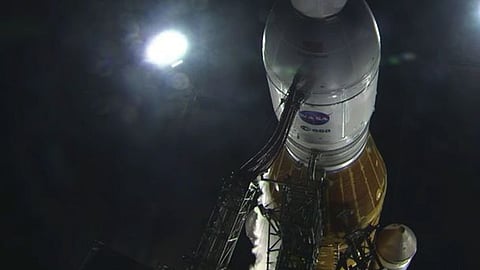

The Artemis 2 mission is taking place in a geopolitical context that is nothing like what existed during the Apollo moon missions. Then, it was a world emerging out of colonialism.
The newly independent nations were filled with optimism and looked at America as the new superpower, free of the rapacity of imperial Europe.
When the first crewed flight of Apollo 7 took place in 1968, the US’s depredations in Latin America and its war in Vietnam were not high in the public conversation. America to Third World elites meant rock n roll and peace and love, and so, when Neil Armstrong stepped on the moon and said it was a giant leap for mankind, they were willing to be seduced. Although the space race was in fact impelled by the Cold War rather than any global altruism, the whole world was taken by the romance of the moon landings. The space programmes of several countries, including India’s, were inspired by it, and that’s something to be grateful for.
It’s a very different world now, but one can argue that the US remains the same. Just as it was involved in an unjust war in Asia then, it is entrapped in one now, screaming in agony, now as then, that it is having to kill so many innocents. The Artemis 2 mission is taking place at a time when the US has recast itself as a white supremacist country whose President makes no apologies about wanting to ‘take’ Iran’s oil, having already done so of Venezuela’s. The rest of the world barring the few countries in Western Europe who will inevitably bend to the colonial arc shortly thus finds it hard to participate in the celebration of man’s return to the moon’s orbit. Unlike Armstrong’s feat, the Artemis 2 voyage struggles to excite the imagination and is easily displaced in the headlines by the sheer wantonness of America’s destruction of Iran and the cruelties committed in Lebanon by its master, Israel.
While NASA frames the Artemis mission as a "momentous step forward for human spaceflight" and its astronauts are working up the pale blue dot theme, it’s hardly a secret that this is a venture for resource extraction, which makes rather a nice fit with the colonial metaphor. Trump’s America explicitly states that space is not a global commons but a for-profit opportunity with major participation by billionaires. So, shoving aside the UN Committee on the Peaceful Uses of Outer Space (COPUOS), it developed a series of bilateral agreements, collectively called the Artemis Accords, with 61 countries, including India.
This arrangement is a feint past the 1967 Outer Space Treaty that forbids national appropriation or sovereignty over celestial bodies. The Artemis Accords allow space powers to create “safety zones”, which entitle them or their private partners to plant a flag in a resource-rich area and effectively assert sovereign control over that territory. Which, if one remembers, was how French Polynesia came to be French and the Falklands British.
It's still quite some distance away, but the Artemis missions are a giant leap for billionaires. When ultimately these missions lead to a permanent and sustainable human presence on the moon, private companies can own, sell, and profit from the resources they extract from the moon.
A skein does run from Armstrong to Artemis, though. First come the explorers. Then the merchants.