
- Chennai
- Tamil Nadu
- India
- World
- EntertainmentEntertainment
- Business
- Sports
- Lifestyle
- Technology
- Videos
- Explainers
- Editor's Picks
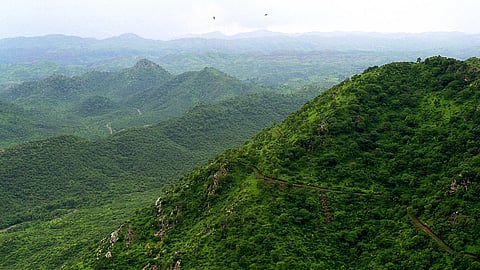
Finally, after rejecting concerns raised by environmentalists about mining in ecologically sensitive Aravalli Hills, the Centre has issued an order banning new mining leases in the hill range. While this has offered a much-needed relief, especially considering the severe air pollution that has been choking the northern parts of the country, activists opine that the main concerns that they have put forth remain unaddressed.
It started with the Supreme Court’s endorsing the Centre’s plan, much to the shock of environmentalists, who argue that using height as a parameter for ascertaining what a hill is neither scientific nor helpful in conservation of old land formations of huge ecological importance.
Opinion is divided on the issue, as the government justified its stand and argued that it would help in better regulation, while environmentalists fear that it would make the range vulnerable to destruction, and it is wiser to err on the side of caution, as the potential damage cannot be undone.
There is no clarity regarding the possible impact of the 100-metre definition. The government has been insisting that only a minuscule part of the ranges would be opened for mining, while environmentalists fear that it would remove protection to most part of the hill ranges. The government should set up a scientific committee of experts to give an evidence-based report and completely pause mining in the sensitive zones till then.
The government should also address the concerns and apprehensions of the environmentalists and consider the merit in their demand regarding using a more scientific criterion, which would support ecology and climate resilience instead of enabling mining, construction, and commercial activity.
The government’s explanation that a single definition is needed as the hill ranges are spread across states like Rajasthan, Gujarat, and Haryana, besides Delhi. The definition is to streamline mining, and therein lies the problem. The same logic is being offered in support of the destruction of vast, sprawling forests in central India and other parts of the country.
Some of the metallic minerals available in the region could be imported or mined from other, less ecologically sensitive areas. Also, instead of ravaging ecosystems, the government should develop a circular economy and put in place sustainable practices in mining before embarking on large-scale mining in eco-sensitive zones. Similarly, the government must insist on using alternative mining technologies that will minimise damage to the systems.
Unlike other green zones, the 1,47,000 sq km Aravalli Hills are not in some remote area of the country. It is in the heart of three big and politically powerful states and the national capital region inhabited by the articulate, rich, and privileged sections of society who have taken to the streets.
Parts of the region are already suffering from pollution and other consequences of poor environmental policy, planning, and implementation of laws.
The possible destruction of even a part of the ranges, which function as a natural shield of protection and a barrier, would only exacerbate the problem.
The government should first come up with a comprehensive plan for sustainable mining after mapping the area using a more scientific, pro-Green criteria recommended by a new committee of experts. The limited sustainable mining system should be implemented in tandem with ecological restoration measures.
