
- Chennai
- Tamil Nadu
- India
- World
- EntertainmentEntertainment
- Business
- Sports
- Lifestyle
- Technology
- Videos
- Explainers
- Editor's Picks
Last week, liberals around the world felt encouraged by the victory of democratic forces in Brazil and Serbia. It fed hope that the elections in Israel this week will signal that the tide of global fascism is turning, and a new dispensation might end the genocide in Gaza. However, true to precedent, Israeli voters have not delivered a decisive mandate, and the resulting political deadlock is likely to perpetuate the status quo.
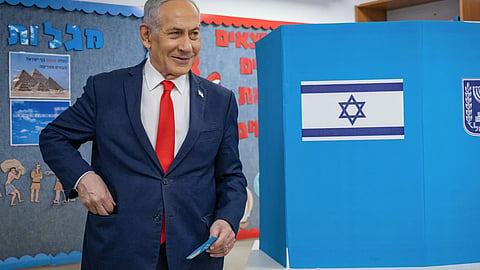
With over 90% of the votes counted, Prime Minister Benjamin Netanyahu’s far-right ruling coalition has secured 53 seats, down from the 68 it held in the outgoing assembly. The opposition Yashar alliance led by former military chief Gadi Eisenkot has 48 seats. Both leaders are sure to fall short of the 61-seat majority in the 120-member Knesset unless they attract new allies. That allows Netanyahu to remain as caretaker prime minister while political parties mix and match their ideologies for a new government.
While Netanyahu’s support has slid a bit and Eisenkot has not been able to prove that he is a credible alternative, it is the performance of the disparate Arab parties as a whole that is notable. They won a record-breaking 19 seats with an aggregate vote share (15%) that is third only to the two leading coalitions. However, both Netanyahu and Eisenkot have clearly said they will not take the support of the Arab parties; so they will not be included in any government formation calculations.
Keeping the Arabs out aptly describes the country Israel has become. The leading political parties both base their exclusion on public opinion, which is hostile to any Arab participation in government. Furthermore, in public opinion surveys, a vast majority supports the military action in Gaza and the settlement policy in occupied territories.
Ahead of the vote, Western media reports had positioned Eisenkot as an alternative to the unpopular Netanyahu. But the military man offers little difference as far as the treatment of Palestinians or the Greater Israel project is concerned. As military chief, it was he who fashioned the Dahyieh Doctrine of deliberately targeting civilians and civilian infrastructure in Lebanon. Both Netanyahu and Eisenkot are committed to the total elimination of Hamas rule and maintaining Israeli security control over the enclave. So this vote can hardly be seen as the Israelis’ verdict on the Gaza genocide and other atrocities. At best, it’s a slap on the wrist for Netanyahu for mishandling security leading to the Hamas attack on Oct. 7, 2003.
For all we know, the present deadlock may lead to Netanyahu becoming Prime Minister again if he attracts enough defectors or makes common cause with Eisenkot for a national government. There are precedents for this. At the very least, he gets to continue as PM in a caretaker capacity until a new government is formed, which may take weeks or even months.
Should power pass to Eisenkot, the only palpable change will be in how Israel treats America. The former military man may not have the heft Netanyahu has in the US Congress and the White House, by exercising which he got Washington to fund his war to the tune of 26 billion dollars. But then there are any number of billionaires and fundraisers who can provide the new incumbent the necessary introductions and lubrication.
