
- Chennai
- Tamil Nadu
- India
- World
- EntertainmentEntertainment
- Business
- Sports
- Lifestyle
- Technology
- Videos
- Explainers
- Editor's Picks
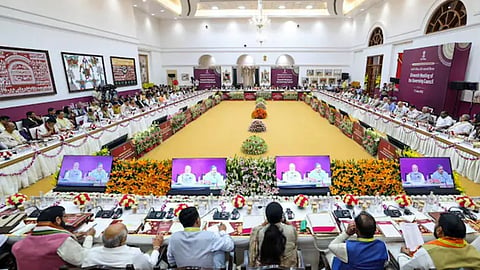
For a change, Chief Ministers of all 28 states in the country were in attendance at the 11th Governing Council meeting of NITI Aayog in New Delhi. The meeting was chaired by Narendra Modi, who has not only become the longest-serving Prime Minister, having surpassed the record of the country’s first head of government Jawaharlal Nehru, but also led the party to a definitive victory in West Bengal and Assam. In the past, Chief Ministers belonging to political parties like the Congress, Trinamool Congress, DMK, and CPM would boycott the meeting to protest against the Centre over alleged discrimination and bias in the allocation of funds to non-BJP state governments. The full house points to the political complexion turning more saffron, and the political climate appears to be favouring the BJP, which has emerged stronger recently.
As is his wont, the Prime Minister claimed that the Centre and the states were working together in a spirit of cooperative federalism. He was emphatic about “India’s growth story” which, according to him, continues to inspire the world at a time when many major economies are facing uncertainty and economic challenges. Given the ongoing geopolitical crisis due to the US-Israel war on Iran, which has disrupted crude oil and natural gas supplies for nitrogen-based fertiliser units, the Prime Minister spoke about renewable energy and organic farming practices.
There is considerable merit in the claims of critics of the Modi government that the federal structure has been consistently undermined since 2014 on an unprecedented scale. The centralisation of power peaked in recent years, leading to the erosion of state autonomy. Often, states are deprived of any power or agency, as is evident in how central schemes are thrust on them. Also, federalism took a hit through the partisan use of central institutions and occasional legislative overreach. Political observers argue that the BJP seems to be in a tearing hurry to push for delimitation, which is likely to further alter the somewhat skewed balance of political power and thereby adversely impact cooperative federalism. In fact, some opposition parties consider NITI Aayog itself a symbol of the strengthening of the unitary strand in fiscal governance in the garb of enabling national coherence and at the cost of regional autonomy. As mentioned in a previous editorial (28 Apr 2026), NITI Aayog lacked the financial and other clout its predecessor, the Planning Commission, had. Secondly, the Aayog lacks the autonomy to promote federalism as it is closely aligned with the Centre.
However, non-BJP Chief Ministers had come with their respective state-centric wish lists. The Tamil Nadu Chief Minister wanted the Centre to let the State fill its quota of seats without NEET marks. Karnataka’s DK Shivakumar sought the allocation of additional infrastructural grants, while his Telangana counterpart pleaded for financial assistance to expedite the implementation of major projects. Likewise, Jammu and Kashmir Chief Minister Omar Abdullah wanted the extension of the special development assistance scheme ‘Pride of Hills’ to the Union Territory. Whether it is the dawn of a new pragmatic realism or a symbolic, civil gesture befitting the occasion, it is obvious that the new generation of opposition leaders wants to be seen as willing to play ball. However, it may not reflect or be in alignment with the broader political strategy of the Opposition to fight the BJP’s tendency to centralise power and exercise it unilaterally.
