
- Chennai
- Tamil Nadu
- India
- World
- EntertainmentEntertainment
- Business
- Sports
- Lifestyle
- Technology
- Videos
- Explainers
- Editor's Picks
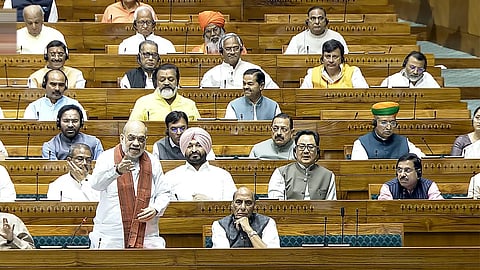
A special three-day session of Parliament is debating two bills — and a third enabling their application to Union territories — designed by the BJP-led Union Government’s factory of Machiavellian measures to push through a delimitation exercise that is dangerously detrimental to the South and the Northeast while increasing North India’s say in Parliament.
All this while using as a cover the already legislated 33% reservation for women in the Lok Sabha and state legislatures, on which there is an existing consensus. Women, who have waited for more than 30 years for their just quota to come into being, are likely to look at the complicated jiggery pokery being enacted by the ruling party and say, “there go the men again.” There is no justifiable reason why the quota for women is being linked, yet again, to a non-germane issue, that is delimitation, if not to muddy the water and provide cover to a gerrymandering move that is seeded against the South and has serious implications for India’s nationhood.
On the face of it, the two bills — the Constitution (131st Amendment) Bill and the Delimitation Bill, 2026 — are meant to operationalise the law for 33% reservation for women, named Nari Shakti Vandan Adhiniyam (NSVA), which was enacted with broad support in 2023. But inside the packaging is a can of worms.
The proposed 131st Amendment purports to raise seats in the Lok Sabha to a maximum of 850, up from 550 now. But while doing so, it removes the current freeze under which the next delimitation could have happened only after a new census has been completed. Which means that delimitation can proceed right away, but only by using data from the latest available census, that is 2011. This brings upon the South the prospect of having a lesser share of seats in the Lok Sabha (down from 24% to 20%) while increasing the share of the North from 38% to 43%. The share of the Northeast, already minuscule at 4.4%, would slip to 3.8%.
If this distribution of seats in the Lok Sabha goes through, it will have introduced unwanted strains into an already iniquitous situation, distorting the national agenda and making it more security-oriented and less development-minded. The current northward slant of policymaking and allocation of resources would get worse, serving only to punish the performing states in the South for the benefit of poorly governed states.
The other major bill introduced, the Delimitation Bill, sets up a Delimitation Commission to redraw constituency boundaries. But its fine print too contrives to use the 2011 Census as the baseline, not the census that began recently and will likely take a couple of years to yield digested data. Which means that delimitation has no chance of being informed by the caste data being collected by the current census. Therefore, underprivileged social groups who are expected to comprise more than 60% of the population will not have been catered for.
Notably, this bit of double-barrelled gerrymandering is being invoked when Tamil Nadu and Kerala are in the throes of their election seasons. The former state is still to vote on April 23, while the latter is awaiting results on May 4. Senior leaders in Tamil Nadu particularly are piqued about not being consulted. But then, the Centre has unwittingly made delimitation an election issue and voters now have a chance to speak their mind on it.
