
- Chennai
- Tamil Nadu
- India
- World
- EntertainmentEntertainment
- Business
- Sports
- Lifestyle
- Technology
- Videos
- Explainers
- Editor's Picks
Chris Kirkland
In the Pilbara of Western Australia, some of Earth’s oldest rocks lie beneath the sky, as they have for billions of years. These dark, weathered volcanic rocks, close to 3.5 billion years old, are cut by veins and stewed by deep time. Their survival is remarkable. Most rocks this old have long since returned to Earth’s interior. These ones, still on the surface, have changed, but not enough to erase their original story.
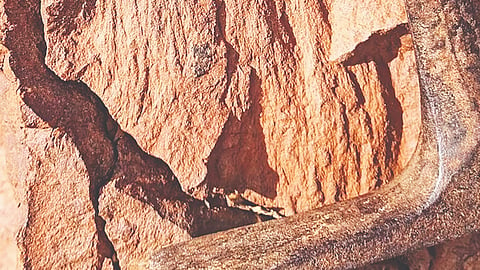
In places, they preserve the rounded forms of pillow basalts — lava that erupted underwater and cooled on an ancient sea floor. The same rock record holds some of the earliest widely accepted evidence for life on Earth. But looking closely at some surfaces, one finds fine lines fanning through the rock. These are shatter cones, the frozen signature of a meteorite shock wave and the clearest sign that something from space once struck Earth.
When our team first reported these rocks in 2025, we suggested they were part of an ancient impact crater at the ironically named North Pole Dome. But one difficult question remained: exactly how old was the impact? In our new study, published in Geology, we used tiny mineral clocks inside the damaged rocks to show that the impact most likely happened 3.024 billion years ago. That makes North Pole Dome the oldest known impact structure on Earth, and the only recognised impact crater from the Archean, the period between 4 and 2.5 billion years ago.
This is a story about a scar on the early Earth, and about geology’s greatest gift to society: the concept of deep time. Humans have existed for some 300,000 years, but Earth is about 4.5 billion years old. Rocks are the pages of that vast story. A geologist’s job is to work out the order of these pages and put dates on them.
Initially, working out when the meteorite struck at the North Pole Dome was a challenge. Early estimates suggested an extremely ancient impact, based on where the shocked rocks sat in local layers. A later Harvard-led study challenged this, arguing the impact could have happened much later, anywhere between 2.7 and 0.4 billion years ago — a span equal to roughly half of Earth’s history.
To find the missing page number, we looked inside the rocks. Tiny crystals can act as clocks, recording when they formed or changed. The key mineral was zircon, which is tiny, tough, and exceptionally good at keeping time. In one shatter cone, we found several types of zircon. Some preserved ages are older than 3.4 billion years, reflecting the ancient rocks that were hit. But another group had skeletal shapes, like tiny frozen lightning bolts, giving an age of 3 billion years.
To confirm this, we needed another clock. We found it in apatite, a phosphate mineral that grows when hot fluids move through broken rock — a system that an impact typically creates. The apatite gave the same age. Two clocks, in different minerals, pointed to the same event about 3.02 billion years ago.
