
- Chennai
- Tamil Nadu
- India
- World
- EntertainmentEntertainment
- Business
- Sports
- Lifestyle
- Technology
- Videos
- Explainers
- Editor's Picks
Black holes are among the most mysterious objects in the universe, but they are not always silent. When two black holes spiral towards each other, they eventually crash in an enormous explosion, forming a single, larger black hole. During this cataclysmic process, they emit gravitational waves — ripples in the fabric of space and time that travel across the cosmos.
The loudest black hole merger event on record was detected last year. Known as GW250114, this collision has now provided an exceptionally clear view of a newly formed black hole. Using this signal, my colleagues and I decoded a previously hidden part of the data, the so-called direct wave, which reveals how rotating black holes drag spacetime around them as they spin. Our research is published today in Nature.
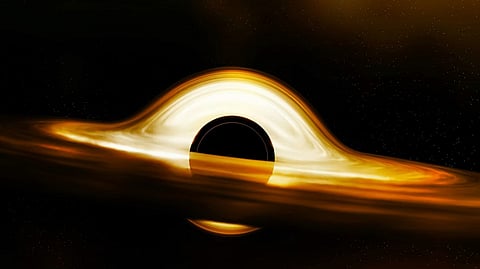
According to Einstein’s theory of general relativity, extreme physics occurs just outside a black hole's event horizon — the boundary beyond which nothing, not even light, can escape. The theory predicts that a rotating black hole does not simply sit in space. Instead, it produces "frame dragging", an effect where the spacetime around the black hole is whirled around with it. Close enough to the horizon, it is impossible to remain still. It acts like a cosmic whirlpool; anything drifting too close is forced to turn, but instead of water, spacetime itself is being dragged.
The direct wave is gravitational radiation that comes from right outside this boundary, where infalling matter experiences intense frame dragging. While the existence of the direct wave is predicted by theory, it had never been detected until now. The wave allows us to study how fast the new black hole is spinning, alongside the strength of gravity at the event horizon.
GW250114 provided the perfect case to hunt for this phenomenon because the signal was so loud. Even so, the direct-wave component was hidden among other waves created by the two original black holes. Our work used new techniques to carefully separate this subtle feature from the louder parts of the gravitational wave signal.
Detecting the direct wave opens up a crucial new source of information. For decades, the event horizon has been central to theoretical physics, but direct data from this region has been difficult to access. Light cannot easily escape from so close to a black hole, making gravitational waves our only viable probe.
Our work also opens a path toward future tests of general relativity. If Einstein’s theory is correct, the direct waves, horizon rotation, and surface gravity must all fit together in a precise mathematical way. Scientists may now look for cracks in current theories to help reconcile general relativity, which describes gravity on a massive scale, with quantum mechanics, which governs physics at the smallest scales. Near the event horizon, gravity is extreme, and studying these waves may finally provide clues toward a deeper understanding of the universe.
The Conversation
