
- Chennai
- Tamil Nadu
- India
- World
- EntertainmentEntertainment
- Business
- Sports
- Lifestyle
- Technology
- Videos
- Explainers
- Editor's Picks
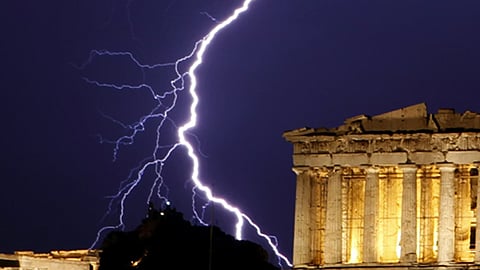
Is it any wonder ancient people thought lightning came from the gods? Even today, a close lightning strike feels like a terrifying brush with the supernatural. Some ancient thinkers, however, suspected the gods had nothing to do with it. They wondered, centuries ahead of their time, if lightning was related somehow to the movement of air and clouds.
In the mythology of ancient Greece and Rome, thunder and lightning strikes were the prime weapon of Zeus (the king of the gods, known to the Romans as Jupiter). Reminders of his power and wrath via lightning strikes were everywhere. The ancient Greek poet Hesiod, writing around 700 BCE, described Zeus hurling bolts of lightning and thunder at his divine enemies. Zeus also struck humans, such as the mythical King Salmoneus, as punishment for demanding his subjects worship him as a god. Surviving Greek and Roman statues depict Zeus hurling lightning bolts as his chief weapon of power.
For the Romans, Jupiter and the gods intervened dramatically in human affairs via lightning strikes. They were often a clear indication of divine displeasure. The father of Pompey, one of Rome’s most powerful Republican generals, was killed in 87 BCE by lightning while on a military campaign. According to Roman writer Plutarch, Pompey’s father was one of Rome’s most hated generals. For many at the time, the gods had dispensed justice.
In about 125 CE, the well-travelled emperor Hadrian climbed Mount Casius in Syria to view the sunrise. When he offered a sacrifice to Zeus, a lightning bolt killed both the attendant and the sacrificial victim. Hadrian himself was spared. In 283 CE, Roman emperor Carus wasn't so lucky. He was struck and killed by lightning while on campaign against the Persians. One ancient account claimed Carus was killed because he campaigned further than the gods allowed.
In the fourth century CE, Greek writer Libanius was struck by lightning while reading a play of Aristophanes. When Marcus Aurelius campaigned against a tribal group in the 160s CE, lightning bolts scattered the enemy. According to the church historian, Eusebius, the legion accompanying him was known as the thundering legion (Fulminata).
Roman religious practice ordered complex rituals surrounding ground struck by lightning. In the Bidental Ritual, priests purified the affected spot. It was then sealed off and forbidden to be walked on. Even the emperor Constantine ordered the performance of traditional pagan rites when public buildings were struck in 320 CE.
While many believed lightning was an instrument of angry gods, not all were convinced. In the play The Clouds, the philosopher Socrates exclaimed: "That’s not Zeus up there – it’s a vortex of air." The first century CE Roman philosopher Seneca believed clouds encountering each other with force caused lightning; if impelled by greater violence, thunderbolts. He saw no role for the gods.
Today, the US Centre for Disease Control estimates 40 million lightning strikes hit the ground annually in the US. The chances of being struck are less than one in a million. Very few still see lightning as a divine weapon, yet it still evokes a sense of supernatural power.
The Conversation
