
- Chennai
- Tamil Nadu
- India
- World
- EntertainmentEntertainment
- Business
- Sports
- Lifestyle
- Technology
- Videos
- Explainers
- Editor's Picks
The 2024 Paris Olympics and Paralympics are remembered for many arresting moments, from the astounding Opening Ceremony on the River Seine, to the grand return of champion gymnast Simone Biles.
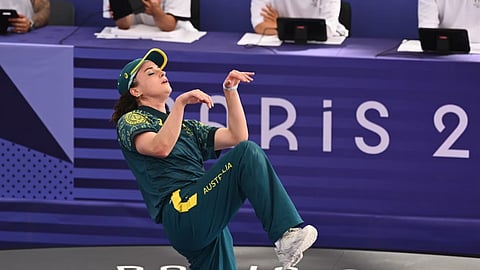
Less conventionally, millions will recall the performance of Australian breaking athlete B-girl Rachael Gunn – aka Raygun – that reverberated wildly across the globe for long afterwards.
Recognising that she could not match her rivals in athleticism, Gunn devised a breaking aesthetic based on Australiana. Dressed in an Australian tracksuit, she executed kangaroo hops, uncoordinated rolls, and sprinkler-like arm movements, trying to impress the judges with creativity rather than power moves. The calculation failed comprehensively: she lost all three of her round-robin battles without scoring a single point.
Although an Olympic judge praised elements of her performance, the backlash that followed was overwhelming.
That dramatic fallout forms the core of a new Netflix documentary, Untold Raygun: Breaking Badly, directed by US filmmakers Chapman Way and Maclain Way. Given the exhaustive media coverage, including a 2025 ABC Inside Story special, viewers may well ask whether there is truly anything new left to explore about Australia’s most polarising athlete.
Gunn was criticised and mocked in a digital tidal wave of legacy news stories, meme-rich social media, and barbed observations by celebrities including Snoop Dogg and Adele. She became comic fodder for US late-night talk shows. Some in the Australian break scene even felt she had satirised them.
Worse, false accusations started to spread of Gunn conspiring with her breaker husband/coach Samuel Free (and others) to rig her selection for Paris. The rumour led to a Change.org petition, which was later withdrawn.
A bitter legal dispute followed with Sydney comedian Steph Broadbridge over a planned parody, Raygun: The Musical, which Broadbridge scrapped after receiving a stern legal letter from Gunn’s lawyers.
Breaking Badly frames these events around Gunn’s perspective. Notably, executive producer Stephanie Scicchitano is also the managing director of the company that represents Gunn.
If viewers are expecting bombshell revelations, they will be disappointed. The film delivers a sympathetic portrait of Gunn’s journey before, during, and after Paris, backed by warm commentary from her husband and parents, while omitting her legal actions against Broadbridge.
Outside commentary is largely restricted to Australian B-girls Tinylocks (Sammy) and Flix (Leah Clark), whose relationship with Gunn combines long-standing rivalry with personal camaraderie. Both express genuine frustration over her Parisian performance. While the film captures Gunn as a vulnerable competitor, a credentialed academic, and a self-aware critic, it avoids challenging her choices, gently coaxing viewers into her corner through protective storytelling.
The narrative concludes on a cheerful note, depicting Gunn aboard a Virgin Voyages ocean liner following a high-profile partnership with billionaire Richard Branson. Having left academia to break full-time, she reflects on navigating her dual identity as Rachael and Raygun. The final scenes feel less like a candid documentary resolution and more like a carefully staged brand relaunch.
While television standardises and packages Gunn’s saga, broader media lessons demand attention. Breaking Badly highlights how modern sports coverage inflates minor spectacles into global scandals, eclipsing far weightier issues such as UN critiques regarding French security measures during the Games. Virality thrives on click-driven comedy, yet deeper cultural fractures lie beneath the global laughter.
Breaking’s inclusion in the Olympic programme was contentious long before Paris, and the widespread mockery directed at Gunn damaged the reputation of the wider breaking community, particularly her Australian peers. Gunn rightfully notes in the film that misogyny amplified the hostility she faced; few observers remember that Australia’s male breaker, J Attack (Jeffrey Dunne), managed just two votes in his battles.
However, her gender struggles were cushioned by her socio-economic standing as a white, well-educated academic raised in Sydney’s affluent Upper North Shore. Breaking originated as a hip-hop movement built by working-class African American and Puerto Rican youths, and Australia’s local scene remains driven by young people of colour. Critics who label Gunn a cultural tourist argue her routine unintentionally lampooned a community she sought to represent.
Breaking Badly demonstrates how an athlete can be completely overwhelmed by the unforgiving machinery of the modern media sports cultural complex. Ironically, Gunn has now chosen to revisit that ordeal on a global streaming platform. Readers and viewers are left to consider their own role in the collective public spectacle that created Raygun in the first place.
