
- Chennai
- Tamil Nadu
- India
- World
- EntertainmentEntertainment
- Business
- Sports
- Lifestyle
- Technology
- Videos
- Explainers
- Editor's Picks
The air in Chennai today didn't just carry the usual salt of the Bay of Bengal; it carried the weight of a tectonic shift in Dravidian history. As C Joseph Vijay — known to millions as ‘Thalapathy’ and now, officially, as the Chief Minister of Tamil Nadu — took his oath of office, the 62-year-old duopoly of the DMK and AIADMK finally cracked. But as the cinematic whistles of the crowd fade, the new government faces a screenplay far more complex than any high-octane thriller: a state balance sheet that is bleeding red and a manifesto that promises the moon, the stars, and a monthly stipend to go with them.
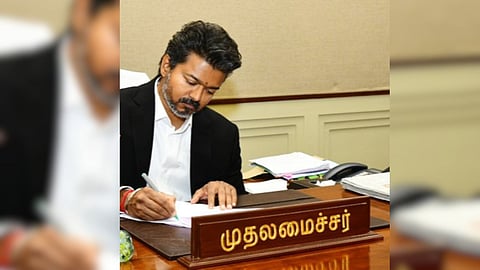
True to his penchant for grand reveals, CM Vijay’s first act today involved the signing of five key files, effectively operationalising the pillars of the Tamilaga Vettri Kazhagam (TVK) manifesto. Power subsidies to households, women's safety, anti-narcotics drive, and a white paper on state finances 2021-26 form the salient features of these orders.
Other manifesto items, ranging from the Rs 2,500 monthly honorarium for women heads of household to the immediate waiver of cooperative crop loans for small farmers, may probably be considered in the coming months. The most intriguing of the manifesto promises, however, was the establishment of India’s first Ministry of Artificial Intelligence. By positioning AI not as a buzzword but as a department for governance efficiency, Vijay is attempting to signal a "clean break" from traditional patronage politics. His inaugural speech was a masterclass in his new brand of secular-populism, rooted in the Thirukkural ideology of “Pirappokkum Ella Uyirkkum” (all are born equal). He spoke of "honest administration" as the ultimate welfare, a direct jab at the corruption narratives that plagued his predecessors.
However, the poetry of the swearing-in must now meet the prose of the state treasury. Tamil Nadu’s fiscal reality is, to put it mildly, sobering. As of 2026, the state’s outstanding debt is hovering near the Rs 10 lakh crore mark. With committed expenditures — salaries, pensions, and interest payments — swallowing over 55% of the total budget, the "fiscal space" Vijay needs to manoeuvre is less a ballroom and more a corridor, though the white paper mentioned above may shed some light on this.
The TVK manifesto is a masterpiece of compassionate economics, but its price tag is astronomical. Consider the "CM People Service Associate" scheme, which aims to hire 5,00,000 youth at the village level with a monthly salary of Rs 18,000. While this addresses the acute unemployment crisis that fuelled Vijay’s youth-led surge, it adds a recurring annual burden of nearly Rs 10,800 crore to the exchequer. Combined with the women’s cash transfer and the promised MSP of Rs 3,500 for paddy, the new government is looking at a welfare bill that could widen the revenue deficit to levels that would make even the most liberal economist wince.
Tamil Nadu remains the "Detroit of Asia," yet its MSME sector — the backbone of its industrial identity — has been gasping for air. The promise to waive the electricity tax for MSMEs for five years and rationalise power tariffs is a savvy move. It recognises that you cannot fund a welfare state if your industrial engine is stalled.
Yet, the challenge lies in the "How." To reach the promised $1.5 trillion economy goal, the TVK government cannot rely solely on the State's credit guarantee funds. It needs to attract high-value FDI in semiconductors and green energy while simultaneously managing the populist demand for freebies. Vijay’s speech today alluded to a "new deal" for Tamil Nadu, but the transition from a consumption-led economy (driven by handouts) to an investment-led one (driven by infrastructure) is a tightrope walk.
The implementation of the TVK manifesto faces three primary hurdles:
Revenue Mobilisation: Without raising taxes — a move that would be political suicide for a new CM — how will the TVK fund its "Gold for Brides" and "Free LPG" schemes? The reliance on central devolution and GST compensation remains a point of friction.
Administrative Inertia: The "Right to Service Act" and the "State Whistleblower Act" announced today are noble, but dismantling the deeply entrenched "percentage culture" (systemic kickbacks) within the bureaucracy will require more than just a charismatic leader; it requires a structural overhaul.
The Debt-to-GSDP Ratio: If borrowing continues to outpace growth, the State risks a credit downgrade that could dry up the very private investment Vijay needs to create those 500,000 jobs.
Vijay has successfully convinced the electorate that he is the "alternative." He has bypassed the traditional "Dravidian vs Aryan" or "Kalaignar vs Amma" tropes to offer a tech-forward, welfare-heavy vision of Tamil pride. Today's speech was devoid of the usual vitriol; it was the language of a CEO-turned-statesman, focused on "service delivery" and "accountability."
But the honeymoon will be short. The markets are watching, and the common man’s expectations are at a fever pitch. If the TVK government can leverage its Ministry of AI to plug leakages and use its massive mandate to reform the State's power utilities (Tangedco), it might just pull off an economic miracle.
For now, the script is written, and the first scene was a blockbuster. But in the world of governance, there are no "retakes." CM Vijay has five years to prove that his vision for Tamil Nadu is a sustainable reality, not just a three-hour cinematic escape. The "Victory" (Vettri) is won; the "Growth" (Valarchi) starts tomorrow.
With the State’s debt clock ticking, the "Thalapathy" must now become the "Thalaimai" (Leader) who balances the heart of a poet with the ledger of an accountant.
Dr Badri is Fellow, NITI Aayog
