
- Chennai
- Tamil Nadu
- India
- World
- EntertainmentEntertainment
- Business
- Sports
- Lifestyle
- Technology
- Videos
- Explainers
- Editor's Picks
When a grizzly bear attacked a group of fourth- and fifth-graders in western Canada in late November 2025, it sparked more than a rescue effort for the 11 people injured – four with severe injuries. Local authorities began trying to find the specific bear involved in order to relocate or euthanize it, depending on the results of their assessment.
The attack, in Bella Coola, British Columbia, was very unusual bear behaviour and prompted efforts to determine exactly what had happened and why. Based on witness statements, officials believed the bear was a mother grizzly with two cubs. Searchers combed the area on foot and by helicopter and trapped four bears. DNA comparisons to evidence from the attack cleared each of them, and they were released back into the wild. After more than three weeks without finding the bear responsible, officials called off the search.
The case highlights the difficulty of identifying individual bears, which becomes especially important when one is exhibiting unusual or dangerous behavior. Bears tend to look alike to untrained observers, and while DNA testing is highly accurate, it is expensive and requires physical contact with animals. Trapping and handling are stressful for bears, and wildlife managers try to minimize such interventions.
Recent advances in computer vision and artificial intelligence offer a possible alternative: facial recognition for bears.
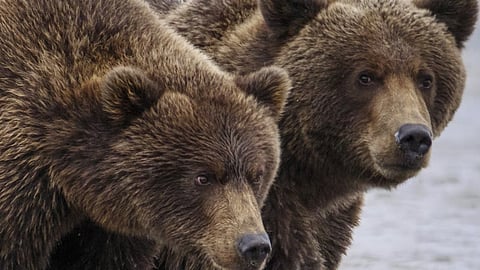
One such tool, called BearID, is under development by computer scientists Ed Miller and Mary Nguyen in collaboration with Melanie Clapham, a behavioral ecologist working with the Nanwakolas Council of First Nations in British Columbia. BearID uses deep learning to analyze photographs and identify individual bears. Its image database includes photos taken by naturalists at Knight Inlet, British Columbia, and by park staff and photographers at Brooks River in Katmai National Park, Alaska.
Although bears’ bodies change dramatically across seasons, the geometry of their faces – including the relative positions of eyes and nose – remains stable. BearID measures these features and compares them across images, allowing a photograph taken today to be matched with one from years earlier.
Beyond identifying bears involved in human conflicts, such tools could help wildlife managers better estimate population sizes and support behavioral research by enabling long-term tracking of individuals. Miller has also developed a web tool to automatically detect bears in Brooks River webcams, and the team is adapting similar methods for Andean bears in Ecuador.
Facial recognition technology is controversial when used on humans, with critics warning of threats to privacy and civil liberties. For wildlife, the ethical stakes are different, though misuse could still harm animals. At the same time, the technology could help managers make more informed decisions about relocating or euthanising specific bears.
Focusing on individual animals can complicate wildlife management, which is typically based on populations rather than personalities. Still, recognizing individual bears can deepen public interest and understanding. Events like Katmai National Park’s Fat Bear Week, which drew more than a million votes in 2025, show how strongly people connect to known animals.
Tools like BearID may help expand that connection, allowing people to better understand bears not just as a species, but as living communities of distinct individuals.
Emily Wanderer is Associate Professor of Anthropology, University of Pittsburgh
The Conversation
