
- Chennai
- Tamil Nadu
- India
- World
- EntertainmentEntertainment
- Business
- Sports
- Lifestyle
- Technology
- Videos
- Explainers
- Editor's Picks
Today, trans people face politicisation of their lives and vilification from politicians, media and parts of broader society. But in some of history’s earliest civilisations, gender-diverse people were recognised and understood in a wholly different way.
As early as 4,500 years ago in ancient Mesopotamia, gender-diverse people held important social roles with professional titles. These included the cultic attendants of the major deity Ištar, known as assinnu, and high-ranking royal courtiers called ša rēši. What the ancient evidence tells us is that these people held positions of power because of their gender ambiguity, not despite it.
Mesopotamia refers primarily to modern Iraq, as well as parts of Syria, Turkey and Iran. Part of the Fertile Crescent, its name means “land between two rivers”, the Euphrates and Tigris. Over thousands of years, major cultural groups lived there, including the Sumerians and the later Akkadian, Assyrian and Babylonian civilisations. The Sumerians invented writing in cuneiform, which was later used to record Akkadian, the earliest Semitic language.
The assinnu were religious servants of Ištar, the Mesopotamian goddess of love and war, known earlier to the Sumerians as Inanna. A powerful deity who legitimised kingship, Ištar governed sexuality, fertility and warfare. In myth, her descent to the Netherworld halts all reproduction on Earth, underscoring her vital role in cosmic balance. Maintaining her cult was believed to ensure humanity’s survival.
As her attendants, the assinnu tended her temple and performed ritual duties. The Akkadian term assinnu is related to words meaning “woman-like” or “man-woman”, but also “hero” and “priestess”. Their gender fluidity was understood as divinely bestowed. A Sumerian hymn describes Ištar’s power to transform men into women and women into men, to exchange clothing, tools and weapons across genders.
Earlier scholars often interpreted the assinnu as religious sex workers or as eunuchs, but such views rely on outdated assumptions and lack firm evidence. There is no proof they were castrated, and texts even attest to female assinnu, demonstrating resistance to a strict gender binary. Their sacred status granted them magical and healing powers, with incantations invoking assinnu to expel illness. Omens also suggest sexual encounters with them could bring personal benefits. Politically, their influence was significant: a Neo-Babylonian almanac states that a king touching the head of an assinnu would secure victory and obedience.
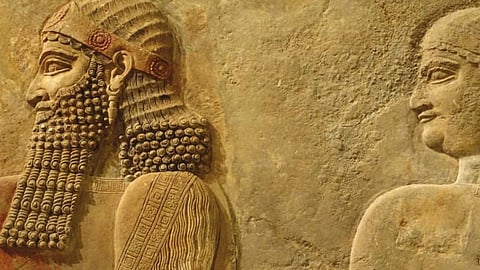
The ša rēši, often translated as “eunuchs”, were elite attendants of the king. The term itself means “one of the head”, indicating their closeness to royal authority. Their duties varied widely, and they could hold multiple high offices simultaneously. Texts describe them as infertile, and visually, they are depicted as beardless, contrasting with other courtiers whose beards signified manhood. Yet they dressed like elite men and visibly exercised authority.
The ša rēši supervised the palace women’s quarters, an area normally closed to men except the king. Deeply trusted, they also served as guards, charioteers and military commanders, sometimes leading armies and governing conquered territories. One even erected a royal inscription in their own name.
Rather than marginal figures, the assinnu and ša rēši show that gender ambiguity functioned as a source of power in Mesopotamian society. Recognising this history reminds us that respect for gender-diverse people is not new, but deeply rooted in human civilisation.
The Conversation
