
- Chennai
- Tamil Nadu
- India
- World
- EntertainmentEntertainment
- Business
- Sports
- Lifestyle
- Technology
- Videos
- Explainers
- Editor's Picks
Krysta Fauria
In Disclosure Day, out Friday, Steven Spielberg is once again inviting audiences to ponder the existence of extraterrestrial life — and the implications it would have for religion on Earth.
But Spielberg is hardly the only one making headlines of late about UFOs and the possibility of life on other planets. What was once considered fringe or conspiratorial has in recent months popped up everywhere from the White House to the Catholic Church, as public fascination with unidentified anomalous phenomena becomes more mainstream.
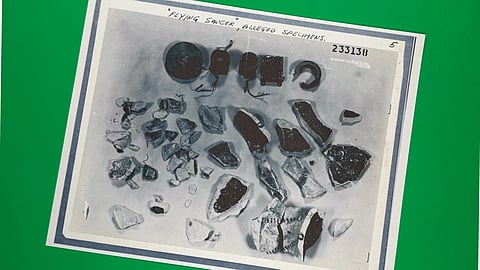
The Pentagon in May made public large swaths of UFO files with very little context, leaving curious sleuths to piece together their own interpretations. The dump came just weeks after former President Barack Obama stated in an interview that aliens are real, though he later tempered that take.
"Statistically, the universe is so vast that the odds are good there's life out there," the former president, who made a surprise visit to the film set, posted on social media. "I saw no evidence during my presidency that extraterrestrials have made contact with us. Really!"
Some religious adherents, as well as some non-believers, maintain that the existence of life on other planets might undermine many faiths because it would complicate assertions that humans are unique. But others argue the opposite.
"Belief in UFOs is really one of the best things that's happened to religion in a long time," said Diana Walsh Pasulka, a religion scholar at the University of North Carolina Wilmington. "It's a blow to the secular, materialist worldview."
Even if broad interest in UAPs bolsters the case for an enchanted universe, some believers in religions such as Christianity think they are something to be wary of.
"I don't think they're aliens. I think they're demons," Vice President JD Vance, a Catholic convert, said in a recent podcast interview.
That sentiment was echoed by Monsignor Stephen Rossetti, formerly an exorcist with the Archdiocese of Washington. He was removed last week by the archbishop, who said statements by Rossetti "gravely undermine" Catholic teaching.
Despite the assertions by Vance and Rossetti about demons, Christopher Baglow, who heads a science and religion initiative at the University of Notre Dame, maintains the Catholic Church has long been open to the possibility of extraterrestrial life.
While meeting with astronomy students last year at the Vatican, Pope Leo XIV spoke about the "ancient light of distant galaxies" and the "mysterious joy" provoked by the study of outer space. Some interpreted these remarks as tacit speculation about the possibility of life on other planets.
The International Raëlian Movement, also known as Raëlism, is a UFO religion that was founded in France in the 1970s. It is still practiced today, with its strongest followings in parts of Asia, Africa and Canada, according to Susan Palmer, a sociologist who studies new religious movements at Concordia University in Montreal.
Its founder, Raël, claims he is a direct descendant of Yahweh, whom Raël visited on the planet of Elohim in 1975. Raëlism claims the Buddha, Jesus and Muhammad are all hybrids of humans and extraterrestrials, as well as Raël's half-brothers.
Of the groups she has studied, Palmer argued Raëlism is the most sympathetic toward UFOs. "They're not interested in extraterrestrial wars," she said.
