
- Chennai
- Tamil Nadu
- India
- World
- EntertainmentEntertainment
- Business
- Sports
- Lifestyle
- Technology
- Videos
- Explainers
- Editor's Picks
In the relatively short time they’ve been around, online dating apps have transformed how we hook up, date and fall in love.
These apps have long been characterised by “swipe logic”: users are shown profiles of others and must swipe left or right to decide whether they like them or not.
When Match Group first introduced this feature through Tinder in 2012, it fundamentally changed the dating scene.
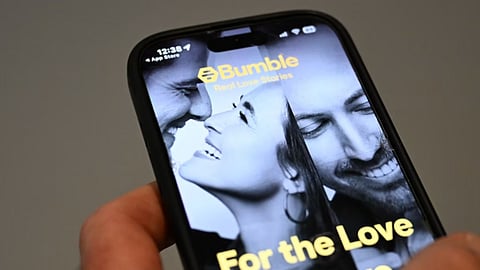
Now, another transformation may be on the horizon, as Bumble has announced plans to shift to AI-powered online dating and retire the swipe. The move raises concerns about the future of intimacy and dating.
Chief executive Whitney Wolfe Herd recently announced that, at some point later this year, Bumble will be introducing an AI-powered dating assistant named ‘Bee’, which is expected to replace the swipe format.
Bee will first chat to users to “get to know them”, before suggesting potential matches and thoughtful date ideas.
Bumble is the first mainstream dating app to overhaul its design to centre AI. But it’s not the first app to use it.
Various dating apps have rolled out AI features over the past few years. Hinge, for instance, has incorporated generative AI tools to help users with conversation starters and to give them feedback on their profiles.
Bumble itself introduced an AI detective feature in 2024 to help boost user safety by identifying fake and scam profiles.
When launched in 2014, Bumble was branded as the “feminist Tinder” because women had control over initiating the conversation.
But it has faced various criticisms since then. For example, research published in 2018 argued the app was optimised to work best for straight, white, cisgender women – meaning they were likely to have smoother or more positive experiences than others.
The app’s “women message first” feature also reinforces the traditional idea that there are two genders (men and women) and each one should play a certain role in relationships.
Academics have been writing about the commodification of intimacy and dating since the late 1990s. Sociologist Zygmunt Bauman theorised we are living in an era of “liquid love”, in which we are “shopping for love”, and looking for shorter, more flexible relations.
Another scholar, Eva Illouz, argued in her 2011 book Why Love Hurts that modern dating is shaped by an abundance of choice, and the pressure to compare and evaluate potential partners can make commitment feel more uncertain.
Dating apps intensify these dynamics. They “platform” intimacy through a market-like system, where profiles (rather than people) are browsed, evaluated and selected. In this environment, it’s common to experience ghosting, stalled conversations, and ambiguity over what the other person wants.
AI matchmaking might reduce the uncertainties of modern dating by narrowing choices and recommending more “compatible” matches. Or, it might just shift the source of the uncertainty.
Users will still have to navigate concerns around chemistry, intention and commitment – and now they’ll also have to decide if they trust the algorithm. They may not want to use AI at all, but will have no choice unless there’s a way to opt out.
AI also introduces potential for bias in how users are “assessed” and matched. Although we don’t know exactly how Bee will work, a plethora of research has shown that AI can perpetuate inequalities and lead to discrimination in various contexts.
As American social scientist Safiya Umoja explains in her book Algorithms of Oppression, algorithms are not neutral systems; they can reflect and amplify existing social inequalities.
On a dating app, this could look like reinforcing gendered dynamics and heteronormativity in who is shown to whom, reproducing racial biases already documented in online dating, and privileging certain lifestyles and markers of class in determining “compatibility”.
Not to mention that if the algorithm is effective in finding matches “like you”, it could be closing you off from a variety of unique people and meaningful experiences.
In a society in which loneliness is on the rise and love is in (apparent) crisis, do people want to use AI dating apps?
It seems unlikely. Research indicates individuals are increasingly looking for more “organic connections”, and we have seen a boom in in-person dating events, from run clubs to social nights and speed dating. Outsourcing matchmaking to AI risks further reducing love and intimacy into something to be quantified and calculated, stripping it of its humanness.
