
- Chennai
- Tamil Nadu
- India
- World
- EntertainmentEntertainment
- Business
- Sports
- Lifestyle
- Technology
- Videos
- Explainers
- Editor's Picks
Tesla’s factory in Shanghai produces far more cars per worker than its plant in California. The gap reflects something unsettling about China’s broader edge in manufacturing: It has figured out how to organise production around large-scale deployment of automation, robotics and artificial intelligence. The United States has not.
Reindustrialisation is one of the few economic goals that now commands bipartisan support. Successive administrations — first Joe Biden’s, now President Trump’s — have made rebuilding American manufacturing a priority. In Washington, the gap between American factories and global competitors is often explained as the product of unfair subsidies, distorted markets or other forms of cheating.
Those factors matter, as does the power of China’s political structure to command fast change from the top down. But the central challenge for the US is not that China bends the rules. Around the world, modern manufacturing no longer resembles the mid-20th-century factory floor. Robotics, automation and AI now make it possible to produce more with fewer human workers, though those who remain are more skilled and better paid. Unlike China, America has failed to reckon with this reality and organise manufacturing in ways that turn its own technological strengths into comparable gains.
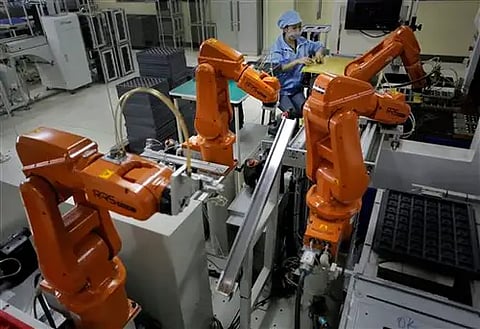
Washington talks about AI as if it lives in research labs, venture capital portfolios and data centres. China treats it as factory work. Today, AI is embedded in China’s efforts to accelerate automation — guiding machines, scheduling work and detecting problems in real time. China has built more than 30,000 smart factories. More than half of all new industrial robots installed worldwide in 2024 went into Chinese factories. Research from Weijian Shan, an investor and economist based in Hong Kong, has found that, in sectors ranging from steel to shipbuilding, these factories now produce more per worker than comparable US plants.
The shift is visible on the shop floor. By last year, the Chinese electric vehicle company Zeekr had more than 800 robots in its factory in Ningbo. The company even experimented with putting humanoid robots to work on its factory floor lifting boxes, assembling components and performing quality checks. Rather than following fixed instructions, the robots use cameras, sensors and AI to respond to conditions on the line, much like driver-assistance systems that adjust to traffic. That flexibility can allow them to handle variation, work safely alongside human workers and absorb routine changes that would otherwise force production to stop. These are the kinds of efficiency gains that can increase productivity per worker and help ease shortages of skilled labour.
These gains are not limited to experimental systems. At Midea, one of the world’s largest home appliance manufacturers, an AI-driven control system coordinates robots, sensors and machines at its Jingzhou plant. A company official said the system has reduced response times from hours to seconds.
Productivity gains come from multiple forms of AI. Software can analyse camera feeds so that defects can be removed from production. Scheduling algorithms can automatically balance production, inventory and logistics — Lenovo, for example, says it has used such systems to cut production scheduling times from hours to minutes. AI can also analyse streams of production data in real time and highlight small inefficiencies before they slow the entire line. The technology company Xiaomi says it used smart manufacturing and more than 700 robots to produce a car every 76 seconds on average in its Beijing plant.
For a decade, Beijing has pursued factory modernisation as a national project, driven by all levels of government, beyond flagship factories like Zeekr and deep into China’s manufacturing supply chains.
Provinces fund local companies developing AI and automation technologies. Government ministries coordinate standards so that suppliers and manufacturers can share data and solutions. The government promotes programmes to train workers to use these technologies. Smaller manufacturers can plug into shared, government-supported digital networks that collect production data, coordinate schedules and monitor equipment, allowing them to adopt AI tools without building from scratch.
On the other side of the Pacific, US policy on AI emphasises frontier research in AI and large language model development. While America leads in these fields, this focus neglects practical areas for using AI and automation, leaving American manufacturers struggling to use digital tools on the factory floor. Only 18% of manufacturers surveyed by the Manufacturing Leadership Council said they have formal AI strategies for their operations; two-thirds said they were struggling to scale AI test projects into production.
Some American manufacturers are experimenting with similar tools. Auto manufacturers like Ford are testing AI-enabled visual detection systems to identify defects on assembly lines. They are also investing in systems that can detect equipment problems before they shut down production lines. Yet these efforts remain fragmented.
The barriers are practical rather than technological, especially for small and midsize companies. In many factories, production data is incomplete or still recorded manually, making it impossible to use digital tools that rely on continuous information. Three-quarters of manufacturers surveyed struggle to connect older machines to systems that could help them run more efficiently. And eight in 10 report shortages of workers who can use AI-powered manufacturing tools. More than half say the upfront cost of AI projects is prohibitive.
Yet the US policy response to China’s rise in manufacturing targets trade flows rather than factory performance. A familiar mix of tariffs, trade investigations and restrictions on imported components and technologies looks tough but does little to close the productivity gap.
These policies actually leave American manufacturers in a bind. When they attempt to automate, they often rely on imported robotics, sensors and machinery. Yet the Trump administration has opened a national security investigation into these robotics supply chains, potentially leading to tariffs that would raise the cost of such modernising equipment.
If the goal is to bring manufacturing back from overseas, American policymakers should focus less on protection and more on helping manufacturers deploy digital tools. America has emphasised invention and breakthroughs over deployment. But sometimes technology needs to be treated as factory work — unglamorous and perhaps boring, but essential for remaining competitive.
The New York Times
