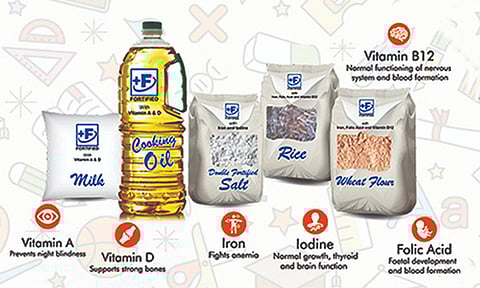

CHENNAI: Calling micronutrient deficiency the State’s next big nutrition challenge, the Tamil Nadu government on Thursday appealed to the public to actively consume fortified rice, wheat flour, edible oil and milk, which will be supplied through welfare schemes and the Public Distribution System (PDS).
Officials termed fortification the ‘most cost-effective population-wide strategy’ to combat deficiencies in Vitamin A, D, B12, folic acid and iron.
Health and Family Welfare Department Secretary P Senthilkumar said that while Tamil Nadu had ‘nearly achieved food security’, the bigger concern now is nutrition security.
“Nearly 50% of women and 20–25% of men in the State are anaemic. This is the gap that fortification can fill, by ensuring minimum nutrient intake,” he said.
The roundtable, convened by the Tamil Nadu Food Safety and Drug Administration (TNFSA), brought together senior officials from multiple departments, including the Social Welfare Department (SWD), Civil Supplies Department (CSD), Integrated Child Development Services (ICDS), Tamil Nadu Medical Services Corporation (TNMSC), National Health Mission (NHM), Directorate of Public Health and Preventive Medicine (DPHPM), Tamil Nadu Civil Supplies Corporation (TNCSC), Aavin, Tamil Nadu Salt Corporation (TNSC), and the Food Safety and Standards Authority of India (FSSAI) – Southern Regional Office.
Nutrition across life stages
A TNMSC representative said the “body is hungry for micronutrients at every stage,” outlining how iron syrup is given weekly to children aged 0–6, and iron–folic acid tablets are provided to those aged 5–19 at government health centres. Under the Dr. Muthulakshmi Reddy Maternity Benefit Scheme (MRMBS), supplements are also provided for pregnant and lactating women.
First 1,000 days crucial
ICDS Joint Director C Malarvizhi stressed the importance of the first 1,000 days of a child’s life, when nutrient absorption shapes long-term health. Appealing to urban families, she urged parents to utilise Kulandhaigal Illams (anganwadis) rather than private day-care centres. She also asked people not to discard the “yellow rice” distributed through ration shops, pointing out that it is fortified with iron, folic acid and B12.
Changing attitudes towards ‘free food’
SWD’s Mid-Day Meal Joint Director Jayalakshmi highlighted that many adolescents, especially girls, hesitate to eat mid-day meals because of the stigma around free food. “Standing in the queue might make them reluctant. But this is their right. To encourage them, headmasters and teachers often eat with students,” she said.
Milk and protein
From the dairy sector, Anbarasu of Aavin pointed to milk as one of the cheapest sources of protein and a vital provider of Vitamin D. He said fortified milk under the ‘Aavin Delite’ line is already being supplied in Chennai, with plans to expand further.
Across departments, the common appeal was that government-supplied nutrition programmes should not be dismissed as substandard because they are free. Officials reiterated that fortified foods are safe, effective, and key to addressing ‘hidden hunger’ in the State.