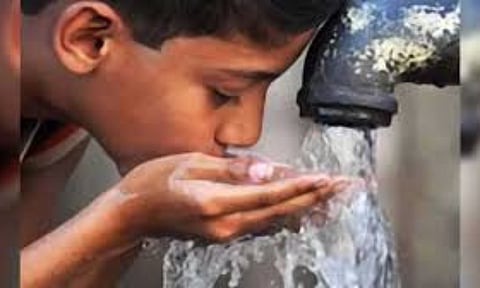

NEW DELHI: More than 15.75 crore (81.37 per cent) rural households are reported to have tap water supply in their homes – an increase of around 12.52 crore after the Jal Jeevan Mission (JJM) was launched in August 2019, Minister of State for Jal Shakti V. Somanna said on Monday.
Data shared by the MoS showed that while several states have achieved 100 per cent coverage of rural households for tap water supply, the worst performers are Kerala (54.77 per cent), Jharkhand (55.09 per cent), West Bengal (56.45 per cent) and Rajasthan (57.55 per cent).
“At the start of the Mission, only 3.23 crore (16.7 per cent) rural households were reported to have tap water connections. So far, as reported by States/UTs as on December 3, 2025, under JJM, around 12.52 crore additional rural households have been provided with tap water connections,” said Somanna.
“Thus, as on December 3, 2025, out of 19.36 crore rural households in the country, more than 15.75 crore (81.37 per cent) households are reported to have tap water supply in their homes,” Somanna said in a written reply to a question in Rajya Sabha.
Sharing details on the funding of the JJM, the MoS said the total outlay for the Mission was estimated at Rs 3.60 lakh crore, out of which the Central share was Rs 2.08 lakh crore. “The approved Central outlay has almost been utilised till 2024-25,” said Somanna.
He said that considering the progress achieved so far and ongoing works, the Finance Minister has announced extension of the JJM till December 2028 with enhanced total outlay through budget announcements 2025-26, focusing on the quality of infrastructure and Operation and Maintenance of rural piped water supply schemes for long-term sustainability and citizen-centric water service delivery.