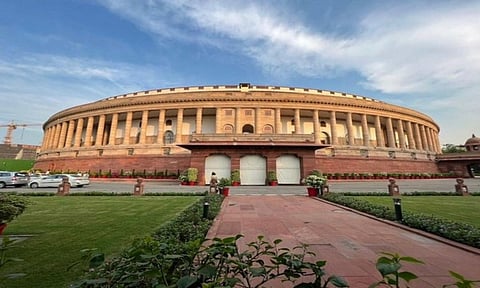

• The winter session of Parliament begins on Monday, Dec. 1, with the odds stacked against the Opposition in its bid to make the Union Government accountable to the people.
First, it has to overcome its own brain fog resulting from the recent Bihar election, which saw the BJP and the Election Commission of India (ECI) collude to produce an astoundingly one-sided result. Second, the session of 15 sittings, the shortest since 2014, is clearly designed to rush through the government’s agenda without giving the opposition time to debate important bills. Third, the opposition has to contend with the Narendra Modi government’s familiar tendency to gaslight and stonewall, aided by partisan presiding officers.
Ten important bills requiring focused debate have been listed in the agenda of the Lok Sabha. Chief among them is the Atomic Energy Bill, 2025, which purports to allow private companies to build small modular nuclear reactors. Having announced in the last budget session that it would limit the liability of foreign suppliers of nuclear equipment in case of accidents, it is clear that the government is bent upon opening up the nuclear sector to private participation and making the deal sweeter for foreign companies. This is fraught with implications of safety and accountability and needs a vigorous debate.
Another important bill coming up, one with great importance to states like Tamil Nadu, is the Higher Education Commission of India Bill, which will create a super regulator for higher education, replacing the University Grants Commission and other bodies to oversee all disciplines other than medical and legal studies. This will greatly expand the Centre’s reach in education, which is in the Concurrent List, and diminish the roles of the states. This is part of the BJP’s greater design to centralise education in the name of standardisation.
The short winter session is also designed to elude accountability on several important issues. High on the Opposition’s list is the special intensive revision (SIR) of electoral rolls, currently being conducted at breakneck speed in 12 states and union territories. The Bihar elections have clearly shown what impact this brazen exercise by the Election Commission of India (ECI) can have on our electoral democracy. In just that state alone, SIR led to the net scrubbing of 4.7 million voters, or 6.3%, from the electoral rolls, and produced a one-sided verdict never before seen in India. Yet, the ECI is ploughing on regardless, acting like an instrument of the ruling party rather than as an autonomous institution of the state.
Apart from these issues, the short session is not likely to have time for topics specific to states that have elections coming up in the new year. Tamil Nadu, as a major contributor of tax revenue to the Centre, has a legitimate grievance on devolution of funds, the recent rejection of its metro rail proposals and the ECI’s commandeering of its bureaucracy for the SIR exercise. West Bengal is aggrieved by the inconsiderate pressure being put upon booth-level officials as part of SIR and the potential disenfranchisement of millions of voters for failing to produce citizenship proof.
The short session of Parliament will also likely help the government pussyfoot past several other controversies that it has to answer for, including the latest revelations in the Jeffrey Epstein scandal in the US, in which the names of Indian businessmen and politicians have figured.