
Chennai
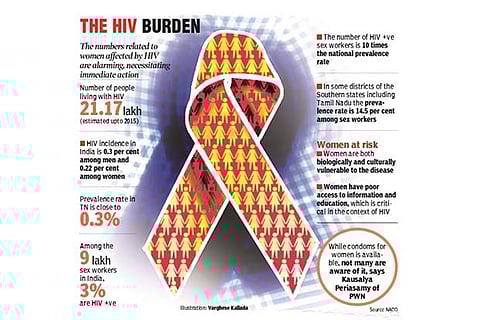
The latest estimates by the central government reveal that women continue to account for 40 per cent of the total HIV population estimated at 21.17 lakh in 2015. Women are the key link as there is high risk of transmission through pregnant women, those without HIV awareness and migrant sex workers who do not have access to healthcare.
The recent study shows a 66 per cent decline in new HIV cases in the last five years with an average of 86,000 new infections. However, the two-fifth of total HIV infections are among women, while children under 15 accounted for 6.54 per cent. Focusing on the key link of women amid changing lifestyles and demographics calls for more steps to spread the awareness among different groups of women, say experts.
No escape for women with single partners, as they are at equal risk
Sathish Kumar, Training Manager, YR Gaitonde Foundation, reveals that among the thousands of HIV +ve people registered with the foundation, 40 per cent are women. “These women are monogamous.
Most homemakers don’t have the freedom socially and economically to make decisions regarding their health. Women in many families do not have the right to insist on condom use either. Since any infection in the vaginal tract increases the risk of contracting HIV by five times, they are biologically and culturally vulnerable to the disease,” he says.
While there is protection available for women in the form of female condoms, how many are aware of it, asks Kausalya Periasamy, Founder, Positive Women Network.
“Everyone, including these homemakers, think that HIV cannot happen to them. But they must understand they are at risk like anyone else,” she says.
When exposure makes women more vulnerable due to casual encounters
While illiteracy is one of the prime reasons for a section of women to be deprived of information, literacy and migration among working women are now factors that have to be considered, says Dr Jaya Shreedhar, Health Communications Consultant.
She says, “Exposure is also a factor. Many women are living alone. Alcohol consumption and sexual encounters are now common and the chances of a woman insisting on condom use after alcohol consumption are remote.” AJ Hariharan, Founder Secretary, Indian Community Welfare Organisation, which has been working towards prevention of HIV, says that efforts must continue towards educating the young population. “Repeated programmes targeting the group alone can help,” he adds.
Mammoth task of reaching out to sex workers
While sex workers have always in the centre of target group, they are still exposed to high risk, adds Dr Jaya. Among the estimated nine lakh sex workers in India, 3 per cent are HIV+ve. Therefore, the number of HIV +ve sex workers is 10 times the national prevalence rate, going by National Aids Control Organisation (NACO) figures. Figures further reveal that some districts of the Southern states including Tamil Nadu the prevalence rate is 14.5 pc among sex workers. “Sex workers are most often migrants and they have no access to healthcare,” adds Dr Jaya.
Visit news.dtnext.in to explore our interactive epaper!
Download the DT Next app for more exciting features!
Click here for iOS
Click here for Android