
Chennai
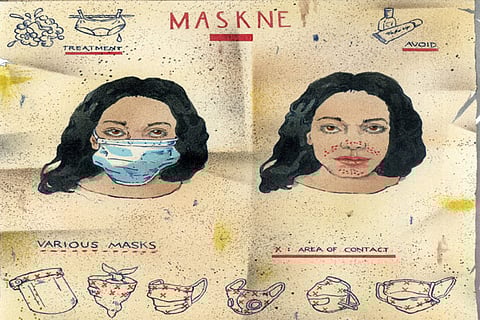
But don’t dismiss maskne — acne and irritation from wearing a mask — as just another portmanteau to market skin care products.
“Oh, it’s a real thing,” said Dr Mona Gohara, an associate clinical professor of dermatology at Yale School of Medicine. She herself has gotten maskne from her three layers of masks: a KN95 (similar to an N95) topped with a surgical mask to keep it clean, plus a face shield for procedures. “Oh, my God, you can just feel things forming with the oil and sweat swishing around,” Gohara said. Maskne — the most common kind is acne mechanica, aka the type of acne a football player may get where the helmet rubs is also enough of a thing that the COVID-19 task force of the American Academy of Dermatology felt compelled to release advice on the subject.
Consider the type of mask you wear
The moisturiser, besides its usual task, can protect skin from mask friction, a la a runner’s chafing cream. Another reason for using fewer products: The mask will intensify product delivery to your skin. (You’ve seen this side effect of occlusion in action if you’ve ever, say, treated dry, cracked feet by applying Vaseline and wearing socks to bed.) But in the case of products with acids or retinols, which can be irritating, intensifying delivery is not likely to be a good thing.
The writer is a journalist with NYT© 2020
The New York Times
Visit news.dtnext.in to explore our interactive epaper!
Download the DT Next app for more exciting features!
Click here for iOS
Click here for Android