
Coimbatore
For a nation marching ahead with an ambitious goal of nutritional security, its contribution from Namakkal, a seemingly backward district in Tamil Nadu, can be relentless. It has been a silent revolution by poultry farmers there, with their eggs reaching far and wide to fulfil the nutritional requirements of one and all. That too, this achievement of theirs has been made possible over a short span of time, thanks to their adoption of advanced technology.
From a modest beginning in the 1970s, egg production has now grown into a multi-crore industry. Namakkal currently has around 1000 egg farms and around three crore eggs are produced every day.
“Our poultry farmers are achieving more than the prescribed production standards due to adaption of new technology, automation and innovative techniques. While the prescribed world standards is only 310 eggs per bird annually, we have gone far beyond by producing 330 eggs in a year. Our poultry farmers are showing the way for other countries to follow,” said Dr PV Senthil, farmer-cum-exporterand general secretary of Livestock and Agri Farmers Trade Association.
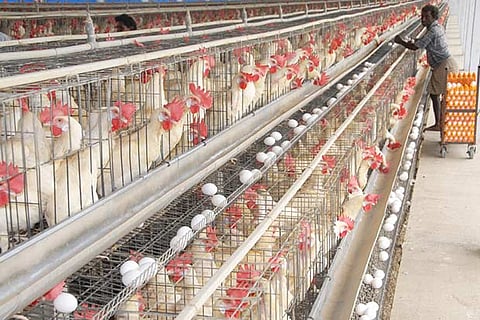
In the poultry sector, the transformation began slow, but has been observed to be phenomenal in the last one decade or so. “Once, the eggs laid by chicks were collected manually. It’s not so now as the egg, soon after it is laid by a chicken, travels on a conveyor belt to reach packing trays segregated on the basis of their weight. Also, automated sprinklers to spray disinfectants on birds have replacedmanual fogging operations,” Senthil added.
Significantly, computerisation of feed management-a critical factor in increasing productivity-has come as a boon to the poultry sector. “The supply of feed to chicks can be controlled through computers. The nutritional requirement of birds may differ day to day based on various factors, including climatic conditions. Based on expert suggestions, the feed supply is now controlled with just a click of a button in our farm. Also, we are able to manage bigger farms with limited workers as manpower shortage has become a challenging task. Besides, automation of the sector has brought down the cost of production,” said K Mohan of SMN Poultry Farm in Namakkal.
With such technologies, the birds’ health also has witnessed improvement and subsequently, has led productivity on an upward spiral.
KS Saravanan, another poultry farmer, said, “Bird deaths due to infections had come down significantly, saving farmers from huge loss, unlike before. When the poultry industry was in its nascent stage, there used to be even 100 per cent of birds dying when a disease breaks out in a farm. Then, all the chicks were raised together in a floor. Of late, bird deaths have come down by five per cent following the introduction of layer method wherein only a few birds are kept in cagesduring their productivity life cycle of 52 weeks.”
Besides, expert suggestions on hygiene change in feed habits based on nutritional requirements, and tips by scientists from TANUVAS through community radio have come in handy for poultry farmers in Namakkal to boost their production.
While technology may have given a strong push to the growth of the poultry industry, it remains a reality that a majority of them are still struggling to give an advanced makeover to their units due to high costs involved. “Only larger farms, which are in low numbers, had adopted to the latest means. Others are still struggling with just conventional methods,” said PV Senthil.
A bird’s-eye view of Namakkal poultry market
Visit news.dtnext.in to explore our interactive epaper!
Download the DT Next app for more exciting features!
Click here for iOS
Click here for Android