
Chennai
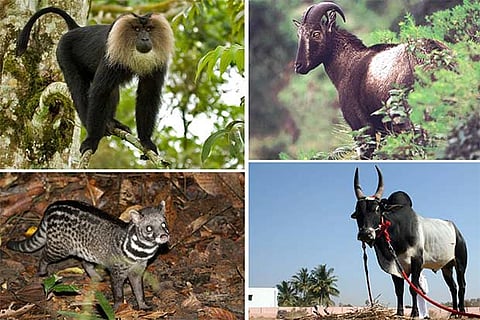
On the occasion of World Animal Day on October 4, here are a few endangered animal species from Tamil Nadu that are fast disappearing.
Lion-tailed macaque
The lion-tailed macaque is a species of a monkey that is omnivorous — consuming mainly fruits and small animals occasionally. With its hairless black face and a broad white mane around it, this species is known for its black tuft at the end of the tail similar to that of a lion. Found in the Western Ghats, spread across the states of Tamil Nadu, Kerala and Karnataka, the macaque was named as one among the most endangered animals in the world. Even though continuous efforts trying to preserve its habitat, it is estimated that there are only around 3,000 lion-tailed macaques currently in the country.
Nilgiri tahr
The Nilgiri tahr, a close relative of sheep, is found in the Nilgiri Hills and the southern region of the Western Ghats in Tamil Nadu and Kerala. The state animal of Tamil Nadu has short, coarse fur and is known for its curved horns. Over the years, the population of Nilgiri tahrs receded, with only a few hundreds of them alive currently. The tahrs which inhabit the open grasslands in large herds across the south Western Ghats, saw a huge reduction in their population due to hunting and poaching.
Malabar civet
The Malabar spotted civet, also known as the Malabar civet, is one of the most threatened animals in the Western Ghats. The civet is known for its distinctive marks on its cheeks, neck and back. Found in the foothill and slope regions, including in Tamil Nadu’s Kanniyakumari to Honnavar in Karnataka, the animal was named as a critically endangered species on the International Union for Conservation of Nature (IUCN) red list. Deforestation and commercial plantations are estimated to be the reasons posing threats to the civet’s survival.
Kangeyam cattle
Drawing their name from the Kangeyam town in Tirupur district of the state, these indigenous breed of cows and bulls are medium-built and are known for their aggressive nature. Even though the milk quality from Kangeyam cows is highly nutritious, the breed is said to be a poor milker, leading to dwindling population of the cattle. The breed is used in Jallikattu, with an intention to bring up the waning numbers of these animals.
Visit news.dtnext.in to explore our interactive epaper!
Download the DT Next app for more exciting features!
Click here for iOS
Click here for Android