
Chennai
Will the Godavari ever wind its way to Tamil Nadu?
As experts debate the pros and cons, and environmental activists express concern, the project can move ahead only if all the States impacted by the project say ‘yes’.
Union Minister Nitin Gadkari has repeatedly said that linking of the Godavari and Cauvery rivers will put a full stop to the water woes of Tamil Nadu.
“We will implement the Godavari-Cauvery river linking project as promised in our election manifesto. This project will benefit not only Tamil Nadu but also Andhra Pradesh, Telangana and Karnataka,” he said. Tamil Nadu Chief Minister Edappadi K Palaniswami welcomed and thanked Gadkari for the project.
Present scenario
The Central government had asked for the opinions of the shareholding States. Tamil Nadu has welcomed the project and has already sent its views. The estimation for the project is still unknown and the source of funding for the project is not clearly mentioned. The funding agencies would have to conduct a feasibility study on the project and only then sanction the loan. Moreover, the State government will review whether the rules and regulations put up by those agencies will fit the bill. After these procedures are over, tenders will be floated. Whether the tenders will be awarded to local companies in parts or to multinational companies is also not clear. According to Public Works Department sources, as far as Tamil Nadu is concerned, it has sought an in-principle approval from the Central government for the construction of the 118.46 km long canal, as part of the project, on Cauvery river from Mayanur to Pudukkottai.
Century-old dream project
The late British irrigation engineer, Sir Arthur Thomas Cotton, was the first one to moot the idea of linking of rivers, especially Ganga-Cauvery, as early as 19th century. He was behind the construction of Prakasam Barrage (across Krishna river) and Dowleswaram Barrage (across Godavari river). Many leaders have echoed Sir Cotton’s views and have been stressing for that.
In 1972, K L Rao, the then Union Irrigation Minister, showed a keen interest in the project, but owing to practical difficulties, the project is yet to take off.
Supreme Court order
In 2002, the then President, A P J Abdul Kalam, in his Republic Day address to the nation, had said that interlinking of rivers was inevitable. It is the only solution for equal distribution of water across the country, as there is heavy rainfall and flooding in one part of the country and severe drought in the other. Senior Supreme Court advocate Ranjith Kumar filed a case stressing for linking of rivers soon after. Tamil Nadu voluntarily joined the case and stressed for it. Hence, the apex court ordered the Centre to find out the feasibility and implement the project early.
Evolution of linking of rivers
The then Prime Minister, A B Vajpayee, also showed a keen interest and the project shaped up. River linking has two parts. The first one is to link 14 rivers, including Ganga and Brahmaputra with Mahanadi, and the second one is to link 16 South Indian rivers across seven States starting from Godavari, Krishna, Pennar, Cauvery, Vaigai to Gundar. Tamil Nadu is showing more interest than the other States in the implementation of the project. Actor Rajinikanth promised to give Rs one crore as his share for the project.
Vajpayee formed a committee under Minister Suresh Prabhu and asked for a project estimation. The committee said that it would require Rs 5.6 lakh crore for the interlinking of rivers project for the entire nation. There was no development after that. But the cost spiralled to Rs 11 lakh crore when the project was re-estimated in 2012. Even today, those at the helm are only talking about the project.
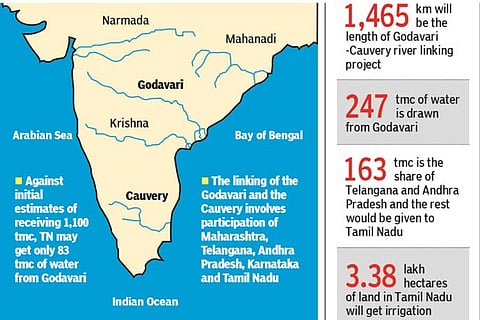
The length of the Godavari-Cauvery project is 1,465 km. It starts from Maharashtra-Chhattisgarh border where a dam would be constructed across Indravati, a tributary of Godavari, and the water would be carried to Kaleshwaram dam in Telangana.
After Telangana’s share, the remaining quantity of water would be carried to Polavaram dam in Andhra Pradesh, then to Nagarjuna dam and drain into Krishna river and the water would be linked to Somasila dam. From there, through Pennar river, the water will be linked to Grand Anicut built across the Cauvery, and through Vaigai river, the water will be drained into Gundar river.
Cost of the project
The cost of the Godavari-Cauvery project is estimated to be Rs 60,000 crore. Nitin Gadkari has said that the Union government will bear 90 per cent of the cost, that is Rs 54,000 crore, and the rest of the cost would be equally shared by the Telangana, Andhra Pradesh and Tamil Nadu governments. But the Andhra Pradesh government has said that the cost estimation is very low and it may require much more. For instance, Chandrababu Naidu’s government started the ambitious project of linking Godavari with Krishna through Polavaram dam in March 2015 and completed it in March 2016. It installed 24 giant pumping stations for the purpose.
The Andhra government has spent Rs 24,000 crore for the project till 2019. It needs another Rs 43,000 crore for finalisation of the project. Hence, the riparian States have said that the cost of the Godavari-Cauvery project will be more.
AP and Telangana’s stand
A point to note is that this project concerns seven States. If you take Godavari river, the consent of Odisha, Maharashtra, Madhya Pradesh, Andhra Pradesh, Telangana, Karnataka and Chhattisgarh is a must for any project across the river.
For Krishna river, the consent of Maharashtra, Karnataka, Telangana and Andhra Pradesh is required. For any project across Pennar, the consent of Andhra Pradesh, Karnataka and Tamil Nadu is needed. So, a project involving all these rivers has to be approached carefully. Already, Andhra Pradesh and Telangana have raised their voices against the project, particularly Telangana, which has already said that it will not let go of its riparian rights on Godavari water.
On January 17, 2018, Nitin Gadkari held a meeting with irrigation Ministers T Harish Rao (Telangana) and Devineni Uma Maheswari (Andhra Pradesh), and convinced them. Since then, there was no opposition for the project.
Water share for States
It is said that the project was to provide water to drought-hit Tamil Nadu from Godavari as 1,100 tmc of surplus water is draining into the sea. Initially, it was said that Tamil Nadu would get 300 tmc of water. Chief Minister Edappadi K Palaniswami said that the State would get at least 150 tmc, whereas Gadkari said that Tamil Nadu would get 125 tmc. But the National Water Development Agency in its draft project estimation has said that it would give 83 tmc of water to Tamil Nadu. It has also said that to start with it would give 46 tmc of water to Grand Anicut.
Only 247 tmc of water is drawn from the Godavari. Had it been distributed through canal, more amount of water could be drawn but since the water is carried through steel pipes, only this much could be drawn. Telangana and Andhra Pradesh would get 163 tmc as their share and the rest would be given to Tamil Nadu. The expectations of Kerala and Puducherry would be known only after that.
The Tamil Nadu government has said that if the water reaches Kattalai instead of Grand Anicut, it would be more beneficial. If the scheme is implemented, 3.38 lakh hectares of land would get irrigation, the National Water Development Agency said. Also, it has said that the project would fulfil drinking water and industrial requirements of the State to an extent.
Practical difficulties
Water experts are discussing at length the pros and cons of the project. The former chief engineer of the Public Works Department, A Veerappan, popular water expert S Janakarajan and Cauvery Calling movement organiser Jaggi Vasudev have expressed that the project cannot be implemented. Even if steps are taken to implement it, the project would result in a lot of environment related problems, geographical and ecological problems. They have also warned that it would affect biodiversity.
Further, Godavari gets surplus water only during July, August and September. In the rest of the nine months, water flow will be low in Godavari, say experts. Scientist V Ponraj and senior engineer A C Kamaraj, however, have said that the project could be implemented and it would be beneficial to people.
If this project has to be implemented, large tracts of land have to be acquired for construction of dams and the government may have to face political and social problems arising out of displacing the tribal people living there.
-News Research Department
Visit news.dtnext.in to explore our interactive epaper!
Download the DT Next app for more exciting features!
Click here for iOS
Click here for Android