
- Chennai
- Tamil Nadu
- India
- World
- EntertainmentEntertainment
- Business
- Sports
- Lifestyle
- Technology
- Videos
- Explainers
- Editor's Picks
Chinese mines and refineries produce most of the world’s rare earth metals and practically all of a few crucial kinds of rare earths. This has given China’s government near complete control over a critical choke point in global trade.
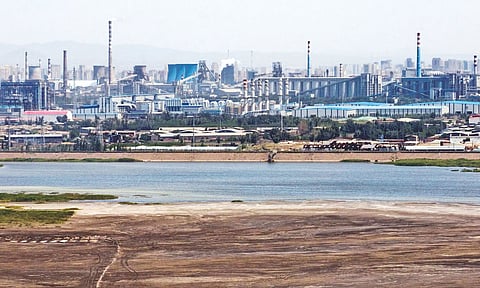
But for decades in northern China, toxic sludge from rare earth processing has been dumped into a 4-square-mile artificial lake. In south-central China, rare earth mines have poisoned dozens of once-green valleys and left hillsides stripped to barren red clay.
Achieving dominance in rare earths came with a heavy cost for China, which largely tolerated severe environmental damage for many years. The industrialised world, by contrast, had tighter regulations and stopped accepting even limited environmental harm from the industry as far back as the 1990s, when rare earth mines and processing centers closed elsewhere.
In China, the worst damage occurred in and around Baotou, a flat, industrial city of 2 million people in China’s Inner Mongolia, on the southern edge of the Gobi Desert. Baotou calls itself the world capital of the rare earth industry, but the city and its people bear the scars from decades of poorly regulated rare earths production.
The artificial lake of sludge known as the Weikuang Dam holds the waste left over after metals are extracted from mined ore. During the winter and spring, the sludge dries out. The dust that then blows off the lake is contaminated with lead, cadmium and other heavy metals, including traces of radioactive thorium, according to technical papers by Chinese scholars.
During the summer rainy season, the sludge becomes coated with a layer of water that mixes with poisons and thorium. This dangerous mix seeps into the groundwater underneath the lake.
The Weikuang Dam, also known as a tailings lake, is 7 miles north of the Yellow River and was built in the 1950s without the thick, waterproof liner underneath that became standard in the West in the 1970s. Baotou’s lake is so large that it cannot easily be rebuilt with a liner.
Government cleanup efforts have helped mitigate some health and safety risks in the industry. But Chinese academics and other experts have warned that environmental damage remains after years of poor practices and lax oversight.
“The closer to the tailings lake, the more serious the pollution and the higher the environmental and ecological risk,” said scholars at the Inner Mongolia University of Science and Technology in a research paper in January.
Similarly, researchers at the elite Chinese Academy of Sciences in Beijing, which is a government ministry, warned in a technical paper last year about “serious air and tailings pond pollution” in the Baotou area.
The Baotou Radiation Environment Management Office warned in 2009 that at the Bayan Obo iron ore and rare earths mine, 80 miles north of the city in the Gobi Desert, radioactive thorium was being “discharged into the environment in the form of waste slag, wastewater and dust.” In 2003, another paper found intellectual development disorders among children in Baotou affected by rare earths industry pollution, and a paper in 2017 found that children in Baotou still had potentially harmful levels of rare earths in their urine.
The enormous Bayan Obo strip mine produces most of China’s so-called light rare earths, like lanthanum for oil refining, and most of its medium rare earths, like samarium for the magnets in fighter jets and missiles. In trade disputes with the United States and the European Union, China has since April halted exports of samarium to any country and has restricted exports of heavy rare earths, which are mined separately near Longnan in south-central China.
During a visit I made in 2010 to the Baotou tailings lake, a berm, little more than a high pile of earth, lay around its perimeter to contain the sludge. Rare earth refineries, then along the north side of the lake, were crude facilities with workers stirring big vats by hand. A nearby residential community had high rates of pollution-related health problems, according to Chinese experts at the time. Baotou itself was shrouded with smog, and the air had an acrid, faintly metallic taste.
Some progress since then is visible. During a return visit in early June, it was clear that the berm had been reinforced with stones. And outside the berm was a concrete-walled moat that could catch leaks from the berm. The residential community had been moved to a less polluted area of the city. Replacing it were steel-walled industrial sheds. Few people were around. The smog had disappeared, and the air tasted clean.
Dust from the lake is a more difficult problem to resolve. In processing rare earths, acid is used to pry apart the chemical envelope that contains them in nature. Radioactive thorium is almost always released. In Baotou, it was simply dumped into the lake for decades instead of being stored in special repositories, as required in the West.
The Inner Mongolia government announced in 2015 that refineries had begun treating their waste before discharging it into the lake, but did not specify how the thorium was handled.
In the days of the Soviet Union, thorium dust blew across Scandinavia from a tailings pond at a rare earth processing facility in Estonia. The Weikuang Dam has vastly more sludge because the effluent from rare earth processing is mixed into an enormous volume of material from iron ore processing. Any effort to move and store the sludge would be a logistical challenge, and no attempt to do so was visible till June.
©️The New York Times Company
