
Chennai
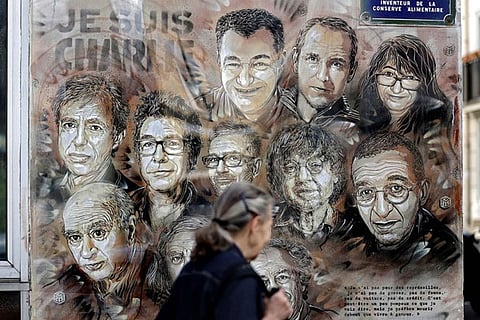
There are photos of the two of them on the walls and shelves and post-its by him everywhere that read “Good night, my love” and “I love you, Maryse, you’re the only one I love”. Five years after terrorists killed the cartoonist during the attack on the satirical magazine Charlie Hebdo, Maryse is still haunted by the memories. “My life got turned upside down — it’s his absence, the absence of his gaze, that had accompanied me for 47 years,” she said. “This absence has made me ill with cancer. And I have regular nightmares. In some of them, I become my husband and live through his last moments facing the Kalashnikov.”
17 people died during the attacks in January 2015. First, Cherif and Said Kouachi fired their Kalashnikov rifles at Charlie Hebdo’s newsroom, then spent several days on the run. Their accomplice took 19 hostages at the Jewish supermarket Hypercacher. The police eventually killed all three assailants. Now, 14 people who allegedly provided logistical support such as cars and weapons to the attackers are in the dock. They could face between 10 years and life in prison. The hearings, which contrary to the norm in France will be recorded, are expected to run until November 10.
Maryse is one of the plaintiffs in the trial that started on Wednesday. She hopes the hearings will provide her with some answers. “I need to understand as well as possible what was in the mind of his assassin, Cherif Kouachi,” she explained. “It’s like any additional information could help me get closer to what my husband went through the moment he got killed.” The magazine was targeted because it had repeatedly mocked the Prophet Muhammad. This attack on the freedom of the press triggered a worldwide backlash. Millions of people took to the streets of Paris a few days later in a show of unity and the slogan “Je suis Charlie” (I am Charlie) went global.
And yet, since the January 2015 attacks, the pressure on press freedom has increased in France particularly with the rise of populist politics and an increasing distrust of the traditional media. A recent survey by polling institute Kantar on behalf of daily newspaper La Croix found that 41% of the French are no longer interested in the information provided by traditional media. That’s a record since the yearly poll was first carried out 33 years ago.
Internet ‘has made things worse’
Charlie Hebdo kept publishing, even right after the attack. It’s now continuing its activities from a secret, heavily guarded location. The magazine still regularly receives threats. Its editor-in-chief Gerard Biard said the internet has made things worse. “Nowadays, when people read critical comments on social media, they immediately take them personally,” he said. “They reply and threaten you in a very violent way. But satire and press cartoons are not supposed to please. They are supposed to be critical, upset people and thought-provoking. That cartoon culture is increasingly getting lost.”
About half of today’s journalists and cartoonists at Charlie Hebdo are new members. Some of the old guard have since left, like Zineb El Rhazoui. She wasn’t at the newsroom when the attack happened — just like Biard. El Rhazoui stills works as a journalist and calls herself an “activist for secularism.” But that fight against radical Islam is getting ever more difficult, she said. El Rhazoui is also under constant police protection.
“We thought at the time we had hit rock-bottom, but that wasn’t the case,” she stated. “Afterwards came the horrible attacks at the Bataclan music hall, the one in Nice in 2016 and numerous others with people yelling ‘Allahu Akbar.’ Since 2015, things really have gotten worse. Radical Islamists have become more and more uninhibited in propagating their views.”
For El Rhazoui, the court case also has a symbolic meaning. “I hope that this will be the trial of an ideology that has killed our friends,” she said. “This view is now so well established and hides behind the freedom of expression to spread its oppressive ideas. And we are hoping that justice will help us mourn this crime.” Paris-based Lawyer Marie Dose appreciates how important the court case is for the victims and relatives. She represents one of those on trial who is suspected of having provided weapons for the attackers and could face up to 20 years in prison.
— This article has been provided by Deutsche Welle
Visit news.dtnext.in to explore our interactive epaper!
Download the DT Next app for more exciting features!
Click here for iOS
Click here for Android