
- Chennai
- Tamil Nadu
- India
- World
- EntertainmentEntertainment
- Business
- Sports
- Lifestyle
- Technology
- Videos
- Explainers
CHENNAI: A tangle of narrow lanes leads into Washermanpet, or Vannarapettai, which began humbly by the waters of the Elambore and the Buckingham Canal, where washermen spread out white calicoes to dry in the sun. This utilitarian beginning, marked by the Company’s trade in cloth, set the tone for a neighbourhood that would always work with its hands. By the late 19th century, the pulse of industry soon followed: metal workshops rang with hammers, textile depots thrived, and beedi factories kept women’s hands busy rolling tobacco leaves into export-bound packets. What was once boundary land grew into the bustling heart of Vannarapettai, fueled by its proximity to the port and Royapuram arteries.
As the city grew beyond its rivers and canals, the railways arrived, and with them, Basin Bridge Junction became the beating heart of north Madras. Lines fanned out from here toward Royapuram, Vyasarpadi, and the harbour, carrying both people and goods. For many families here, the railway yards and workshops meant steady jobs and a daily rhythm defined by whistles and signals.
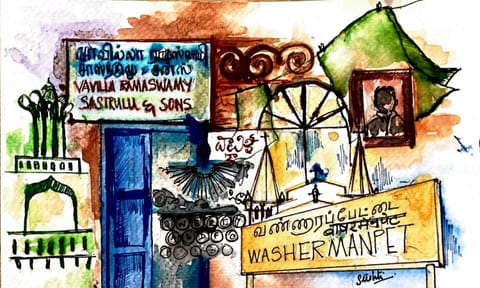
Washermanpet emerged as a working-class stronghold, its streets animated by unions, artisan trades, and print entrepreneurs. Ramanujam Street shelters Vavilla Press, founded in 1854, which once dared to publish Radhika Santwanam, Muddupalani’s bold Telugu poetry on desire, provoking India’s first obscenity trial. The devadasi-poet’s verses, defended decades later by Bangalore Nagarathnamma, became part of the city’s feminist and literary history. Not far away stands Sir Theagaraya College, named for Justice Party leader Sir P Theagaraya Chetty, whose politics shaped early 20th-century Madras. Its halls welcomed generations of first-generation learners from north Chennai, embedding education into a working-class neighbourhood.

The Bavuta Beedi Company, started in 1905 by Shaikh Ismail, once sent chocolate and vanilla flavoured beedis across the seas, rolled by the nimble fingers of Muslim women. In another street, a Mariamman deity was fashioned out of sand by a desperate mother praying for her daughter’s recovery; the temple still stands, tended by women priests. St Roque’s Church, dating back to 1814, arose from a Catholic burial ground, its Luso-Indian families intertwining Portuguese memory with Tamil soil.
Washermanpet thrived not only as an economic hub but also as a political stage. It was here that CN Annadurai electrified crowds at Robinson Park (now Anna Poonga), launching the DMK in 1949, a defining moment in Dravidian politics.
Today, the metro delivers residents swiftly to far corners of Chennai, a transformation that hints at new futures even as the lanes still hum with cricket slang in Madras baashai, the aroma of street food, and the clatter of trade.
What began with bundles of calicoes on the riverbank now runs on tracks of steel, yet Washermanpet’s pulse has never stilled. In many ways, its arc mirrors Chennai’s shift from colonial Madras to a city that is connected, contested, and constantly remade. Its streets tell a story of labour and voice, neglect and renewal, and pose the urgent planner’s question: in stitching it into the network, can we avoid erasing its lived texture?
—The writer is an architect and artist.