
- Chennai
- Tamil Nadu
- India
- World
- EntertainmentEntertainment
- Business
- Sports
- Lifestyle
- Technology
- Videos
- Explainers
- Editor's Picks

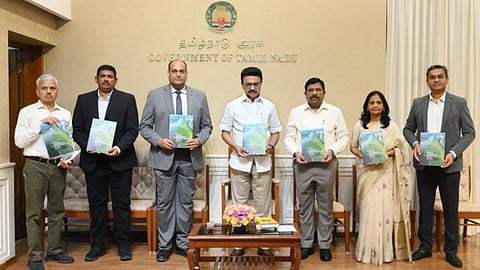
CHENNAI: Chief Minister MK Stalin on Friday unveiled the Tamil Nadu government’s Urban Greening Policy 2026, which aims to transform cities into climate-resilient, liveable spaces by integrating trees, urban forests and green infrastructure into every stage of urban development.
Released under the Green Tamil Nadu Mission, the policy comes at a time when the State’s urban population is projected to reach 67 per cent by 2031.
It seeks to address challenges such as rising urban heat, deteriorating air quality and the steady loss of green spaces through a structured, science-based framework.
The policy document underlined that urban greening is essential not only for climate resilience but also for public health and quality of life.
It envisions restoring and expanding urban forests, neighbourhood parks, green corridors and blue-green infrastructure, including lakes, canals and wetlands, to improve ecological connectivity within cities.
Aligned with the Sustainable Development Goals, the policy sets an ambitious target of increasing Tamil Nadu’s overall green cover from 23.7 per cent to 33 per cent over the coming years.
Urban local bodies have been advised to ensure that at least 15 per cent of municipal areas are maintained under green cover.
Planning tools such as Urban Greening Factors, GIS-based mapping of green infrastructure and the prioritisation of native, climate-resilient tree species have been identified as key instruments to guide implementation.
The framework also places emphasis on equitable access to green spaces, recognising the role of urban greenery in improving liveability in densely populated neighbourhoods.
Community participation has been highlighted as central to sustaining greening efforts, with residents encouraged to take part in tree planting, stewardship and monitoring initiatives.
To steer implementation, the policy proposes a multi-tier institutional mechanism, including State- and district-level coordination committees and dedicated Urban Forest Wings within local bodies.
Funding is to be mobilised through the convergence of State and Central schemes, the introduction of green fees where appropriate and citizen contributions.
Monitoring and evaluation will focus on measurable outcomes such as canopy cover, biodiversity indicators, tree survival rates and public access to green spaces.
These will be tracked through digital dashboards and geo-tagging of plantations, enabling periodic review and course correction as cities expand and densify.