
- Chennai
- Tamil Nadu
- India
- World
- EntertainmentEntertainment
- Business
- Sports
- Lifestyle
- Technology
- Videos
- Explainers
- Editor's Picks

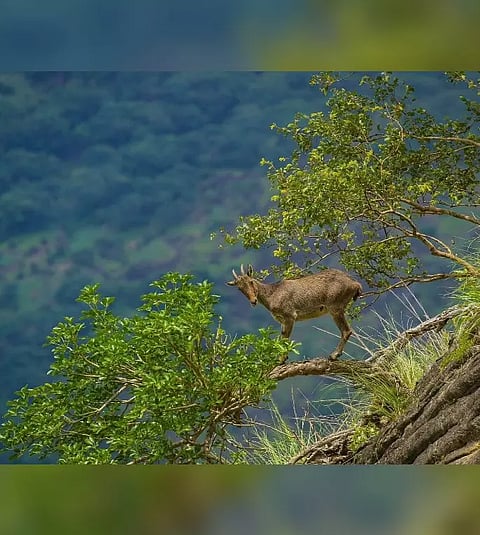
CHENNAI: The Nilgiri Tahr population in Tamil Nadu has been estimated at 1,303 individuals, according to the Second Synchronised Survey released on Monday at Guindy Children's Park.
The survey revealed that 47.3 per cent of the population is found in Grass Hills and Mukurthi National Parks, while the Anamalai Hills account for 42 per cent, together forming the core strongholds of the species.
Releasing the survey report, forest minister RS Rajakannappan highlighted the ecological role of the Nilgiri Tahr and stressed that conservation efforts must be a shared responsibility. “A scientific committee comprising national and international experts has been constituted to steer Project Nilgiri Tahr in line with global standards,” he said.
Additional Chief Secretary of the Environment, Forest and Climate Change Department, Supriya Sahu, announced that land had been allocated for a new Nilgiri Tahr Conservation Centre in Coimbatore. She also noted the species' cultural significance, with references in ancient Tamil Sangam literature.
Srinivas Reddy, principal chief conservator of forest, Rakesh Kumar Dogra, principal chief conservator of forest and chief wildlife warden and MG Ganesan, project director of the project Nilgiri Tahr, were present.
Conducted between April 24 and 27, 2025, across 177 survey blocks in 14 forest divisions, the synchronised survey is part of Project Nilgiri Tahr, a species-specific conservation initiative launched by Chief Minister Stalin in October 2023 with an outlay of Rs 25.14 crore. This year's exercise also saw participation from the Kerala Forest Department and was aligned with surveys in Eravikulam National Park and other parts of Kerala.
The survey involved 786 field personnel who trekked over 3,126 km, using a combination of bounded count and double observer methods. The Kodaikanal division was included for the first time, reviving monitoring efforts in a historically significant Nilgiri Tahr range.
Faecal samples were collected and are being analysed by TANUVAS to study parasitic loads and predator-prey interactions. The male-to-female ratio was found to be 1:2, while the female-to-young ratio stood at 2:1. Nilgiri Tahrs were recorded across elevations from 247 to 2,643 metres above sea level.