
- Chennai
- Tamil Nadu
- India
- World
- EntertainmentEntertainment
- Business
- Sports
- Lifestyle
- Technology
- Videos
- Explainers
- Editor's Picks

CHENNAI: Every three minutes, a life is lost on Indian roads, according to a new time-based data visualisation that reframes the country's road safety crisis as a race against time.
India's 'Road Crash Fatalities Clock (2023)', developed by architect and urban planner Karthikeyan Baskar, translates the Ministry of Road Transport and Highways' Road Accidents in India 2023 report into a real-time visualisation that captures the human cost behind the numbers.
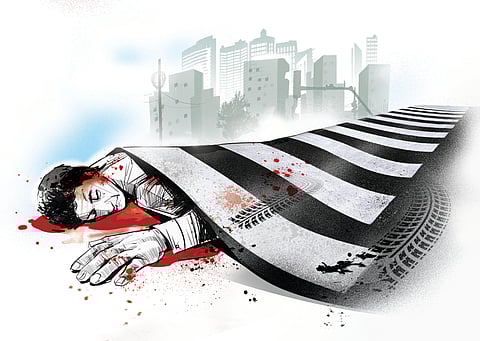
According to the data, a road crash claims a life every three minutes, while a pedestrian is killed every 15 minutes. The visualisation breaks down fatalities by road user category, underscoring the uneven risk borne by vulnerable users.
Every 115 minutes, a two-wheeler rider dies; every 83 minutes, a car, taxi or van occupant loses their life; every 52 minutes, a truck or lorry driver dies in a crash; and every 15 minutes, a pedestrian is killed. In addition, a bicyclist dies every 115 minutes, while a child loses their life every 55 minutes on Indian roads.
While overall road fatalities have shown marginal improvement in recent years, the data reveal that vulnerable users, pedestrians, cyclists, and two-wheeler riders continue to bear a disproportionate share of the burden.
"A road-user is anyone who moves through the public realm, whether on foot, on a bicycle, or in a vehicle. The clock makes it clear who remains most at risk, and where urgent, focused interventions are needed," Karthikeyan explained.
The visualisation urges policymakers and professionals in urban planning, transport, and public safety to view road safety as a cross-disciplinary mission, one that transcends engineering to address questions of design ethics, equity, and governance.
Experts note that safer cities demand more than infrastructure expansion. They require data-informed design, institutional collaboration, and above all, empathy in planning.
"This clock reminds us that road safety is not an annual figure to be reported but a continuous, ticking reality. Every minute counts, and every life matters," Karthikeyan said.