
- Chennai
- Tamil Nadu
- India
- World
- EntertainmentEntertainment
- Business
- Sports
- Lifestyle
- Technology
- Videos
- Explainers
- Editor's Picks

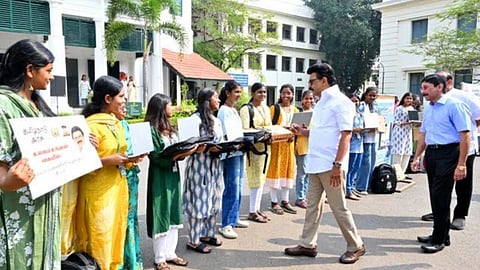
CHENNAI: Chief Minister MK Stalin on Tuesday claimed that the Pudhumai Penn scheme, which provides monthly financial aid of Rs 1,000, has benefited girls from rural areas more than those from urban regions.
"The first major scheme we brought for women's education after the Dravidian model government came to power is the Pudhumai Penn scheme, providing Rs 1,000 per month to girls joining college from a government school.
To understand its impact, I asked the State Planning Commission to study it.
Seeing their findings, rural girls have benefited more than urban ones," he said at a felicitation by All India Association for Christian Higher Education (AIACHE) and Women's Christian College, Chennai.
The Chief Minister said that recently, based on data, women's higher education enrollment has increased by 34 per cent due to the Pudhumai Penn scheme alone in the state. "This is not an ordinary achievement," he said, adding, "about eight lakh girls have benefited".
Stating that many who had dropped out after school due to lack of money and idled at home for years are now returning to studies because of the scheme, he said.
Listing out various welfare schemes for the students, including a breakfast scheme for the government school students through his dream project, the Naan Mudhalvan Scheme, Stalin also mentioned the achievement of a student who can converse well in Japanese and is looking forward to starting a career in that country.
The Chief Minister also said that in the previous regime, 7.5% quota was only for medicine for government school students.
"Now, post our government, we extended it to Engineering, Agriculture, Law, Veterinary too, with the government bearing all fees for the students under the scheme," he said.
He emphasised the importance of education and reiterated that victory does not have a shortcut and only hard work leads to success. He acknowledged that women are beautiful, but education adds more beauty to them.
Addressing the young college students as his daughters, he requested them to consider his address as a fatherly concern and not as advice.