
CHENNAI: Rarely has there been any instance since the days of Emperor Constantine of Rome or St Paul (the early Christian evangelist), when a mass of 20,000 to 30,000 people, denied the religion they practiced for more than a millennium and moved to follow a new faith – Roman Catholicism – at one go.
They are the pearl fishers of the coast of southeast India called Paravas, Parathavas, or Bharathas, who did so at the height of the rivalry and persecution they faced from the Arabian Moors, who conflicted with them for the harvest of pearls from the beds of the Gulf of Mannar. The Moors were supported by the Madurai Nayak rulers. The Paravas were not just fishermen but seafarers.
Origins
According to Historia Ecclesiastica, quoted by Edgar Thurston, the Madras civil servant-turned-anthropologist, who wrote the monumental Castes and Tribes of South India, the Paravas are descendants of the Pharaohs of Egypt, well-versed in astronomy, ship-building and navigation.
A few writers, quoted by Thurston, traced their ancestry nearer home to Oudh on the banks of the Jamuna river. According to the puranas, they are the siblings of Karthikeya, who rose in Saravana Poigai, the sacred tank, to destroy the asuras.
Whatever be the theories on their origin, their mastery over the craft was widely acclaimed. The pearls they garnered from deep oceans were not only the envious adornments of Queen Cleopatra, they also found their way to the court of the Roman emperor Augustus Caesar, whose nobles bemoaned the denudation of gold stocks of the empire in quest of pearls.
The pearl fishery coast and its business houses in Korkai find mention in the journals of Megasthenes, Pliny, Seychelles, and Marco Polo as well.
Social structure
The Paravas had their own social structure where each village had its own commandants of boats and sails and pearl beds. They would delve dangerously into the caverns of the sea and furrow the ocean beds for pearls and chanks.
They had a leader or a Thalaivar for the community called Jathi Thalaivar. They were not subjects of any ruler, nor did they pay taxes, not even to the Madurai Nayaks, who were all-powerful in the 1500s and 1600s. They were free men and no employees of any overlord.
The pearl fishers of the Arab peninsula, who set their eyes on the fishery coast that ranged from Cape Comorin to Rameswaram promontory, struck a deal with the Madurai Nayaks and received the rights to harvest the pearls.
The right to fish pearls in the traditional domain of the Paravas to the Moors ignited conflict between the two communities. This led the Paravas to seek the support of the Portuguese, who had just landed on the western coast for trade in spices. The Portuguese readily rendered support and thereby came into conflict with the Moors on behalf of the Paravas.
Conversion to Catholicism
In return for that support and also to sustain it, the Paravas agreed to become Roman Catholics, the religion of the Portuguese. So at one go, all fishing villages from Rajakkamangalam to Rameswaram turned to Roman Catholicism.
In rendering this help to the Paravas, the Portuguese also stood to gain. They developed a mass of supporters in the alien coast to assist them in their merchandise and political power peddling. Some of them got married locally and cemented their relationship.
They gave their Portuguese family names to local Paravas and thus emerged Fernandez, Mothas, de Cruz, de Cunha, Peres, etc, among the locals. Thurston would humorously remark, “Incongruous as it sounds, Jose Fernandez and Maria Santiago are but humble folk, catching fish in a primitive way, with no more clothing on than a small loincloth and a picture of Virgin Mary.”
The conversion to the Catholic faith, however, was not intrinsic but peripheral and superficial. It was given to saints like Francis Xavier, the Apostle of the Indies, to firm them up in faith. Devout priests like Francis Xavier memorised translations of Latin Catholic prayers in Tamil and went about indoctrinating the Paravas.
The priests appointed the bright among them as teachers and periodically examined them and their wards about their spiritual depth. They paid them decent stipends out of the money sanctioned by Queen Isabella of Spain and did not fail to slash their allowance if there was inadequate progress in rooting the faith.
Yet these spiritual attempts did not markedly invigorate the faithful, as they were steeped in their traditional customs of worshipping Ammans (Hindu deities) and pulling chapparams (small chariots) and vahanams with deities around the streets. It is reported by Hornell, the then Superintendent of the Fisheries, that the first pull of the chariot at Tiruchendur used to be done by the Jathi Thalaivar of the Paravas after offering a bushel of pearls to Lord Murugan in the temple, and half a bushel of pearls to the priest, for having warded off the evil spirits in mid sea from harming the fishers during their endeavours.
In their desire to wean away, the converted Paravas, out of their piety for the Hindu gods and goddesses, substituted Mother Mary for Amman and built chapparams. The car at Our Lady’s church is one. Thus arose many churches dedicated to Mother Mary along the coast from Cape Comorin.
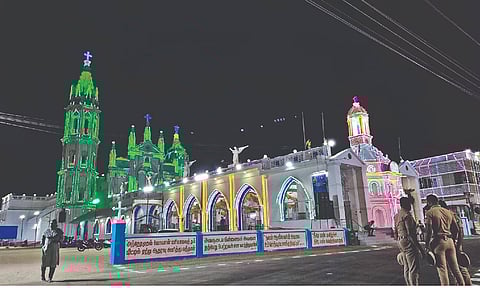
The new Catholics of Thoothukudi chose for themselves Mother Mary in her apparition of the Lady of Snows – Das Nevis. In her honour, a church exists in Thoothukudi which has been declared a basilica.
Lady of Snows

In the summer of 342 CE, it is said that Pope Ligarius had a dream in which he was directed to build a church for Mother Mary on Mount Esquiline in Rome. He dreamt of the mount having an unusual shower of snow, marking the dimensions of the church with Mary appearing in the midst of it, although it was summer then.
Fulfilling the dream, he built a church in her honour on Mount Esquiline and it was called Maria Majore. This was the first church for Mary anywhere in the world. It is this Mary of Snows that the Paravas chose to have at Thoothukudi. They built a church in her honour and installed a statue of Our Lady of Snows in it.
The statue is made of wood, and it has a benign face. Mary holds a figure of the child Jesus in one hand and a fruit in the other.
Some say that the statue was a gift of the Augustinian nuns of Manila to the Paravas in deference to the request of St Francis Xavier during his sojourn in The Philippines and was sent on a ship named St Helena. The statue was, in turn, gifted by King John III of Spain to the Augustinian nuns.
Some others contended that it was from Galle in Sri Lanka, and still others attributed it to have come floating in the sea along with a cross that was given away to the church at Manappad. Though conflicting versions prevail, the fact remains that the priests honoured it and the Paravas hailed her as their own mother.
In the days of conflict between the Jesuits and the Cochin diocesan priests, the Paravas, who deserted Thoothukudi with the Jesuits to Raja Tivu, now called Hare island, took the statue with them. Such was their love for her. Again, when the Dutch took over Thoothukudi and the church, and attempted to convert the Paravas into Protestants, the Paravas took the statue to Shevanthankulam, and worshipped her there stealthily.
Now, the statue stands on a magnificent altar in the basilica overlooking the sea. One can see that she is venerated by devotees of different faiths. Not a soul passes the spire of the church without bowing in reverence. The festival in her honour on August 5 every year attracts Paravas settled all over the globe. Some even fly in by chartered flights.
The statue is not only a religious icon. It is also a cultural symbol, linking the native Paravas with the Paravas of northwest Sri Lanka, who migrated there to escape the onslaughts of the Moors and the Madurai Nayaks. They pay visits to her as often as they can, though the sea parts them.
Susan Bailey, a Cambridge scholar who studied Christianity in South India, feels that the popularity of Our Lady of Snows of Thoothukudi is not as widespread in the south as Our Lady of Velankanni because the Paravas hold Our Lady of Snows exclusively and proudly as their own.
Still, Latinism is smelt in the mass, music, litanies and rituals. But unlike in Goa, where the Portuguese wielded power, they could not turn away the Parava from his Tamil. His prayers and hymns are in flowery Tamil, worth reciting for its music and piety as well as for its lyrical melody.
The writer is a former DGP of Tamil Nadu Police (2004-06)