
- Chennai
- Tamil Nadu
- India
- World
- EntertainmentEntertainment
- Business
- Sports
- Lifestyle
- Technology
- Videos
- Explainers
- Editor's Picks

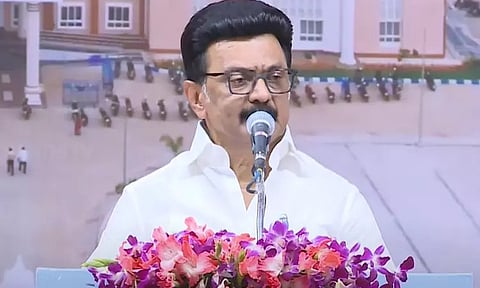
CHENNAI: Despite recovering after discharge from the hospital, Chief Minister MK Stalin took time off to pen a speech which was delivered on Monday at the launch of the book ‘Kaalamthorum Communists’ by poet Jeevabharathi at Kamarajar Arangam.
CM Stalin termed socialism as not merely a political theory, but a value essential for the welfare of the people and the land, in the written message read out at the book launch event.
Stalin also credited socialist ideals with shaping key welfare reforms in Tamil Nadu. Finance Minister Thangam Thennarasu released the book on behalf of Chief Minister Stalin, who was unable to attend due to medical advice.
In his message, Stalin stated that the late DMK leader M Karunanidhi was deeply influenced by socialist thought, which was also reflected in his administration.
As Chief Minister, Karunanidhi had implemented crucial land reforms, including the Land Ceiling Act, to ensure land rights for cultivators. Karunanidhi also initiated schemes such as the formation of the Tamil Nadu Slum Clearance Board and the abolition of hand-pulled rickshaws — all grounded in socialist principles.
Stalin added that the present Dravidian model government continued to walk the same path by implementing welfare schemes for marginalised communities.
He also mentioned the ongoing efforts to install a statue of Karl Marx in Chennai, calling it a symbol of equality and social justice.
Praising the author of the book, Stalin said Jeevabharathi had documented the contributions of 100 Communist leaders, from Singaravelar, the first Communist from South India, to Tha Pandian, who was known for his powerful oratory in Tamil.
CPI general secretary D Raja, who also addressed the gathering, recalled the Communist Party’s origins during British rule and the sacrifices made by its early leaders. He said the country was now facing a new threat to democracy. “It is time for Communists, Ambedkarites, and Periyarists to unite in Tamil Nadu to counter communal forces,” he said.
Speaking at the event, Thangam Thennarasu stated that communism, although often contested, remains constant and eternal in its relevance. “It is a movement founded for ordinary people and the working class. That voice is still necessary,” he said, adding that the book served as both a historical archive and a public resource.