
- Chennai
- Tamil Nadu
- India
- World
- EntertainmentEntertainment
- Business
- Sports
- Lifestyle
- Technology
- Videos
- Explainers
- Editor's Picks

CHENNAI: Tamil Nadu could witness rare off-season rainfall between the last week of February and the first week of March, according to weather blogger Pradeep John, better known by his social media handle 'Tamil Nadu Weatherman'.
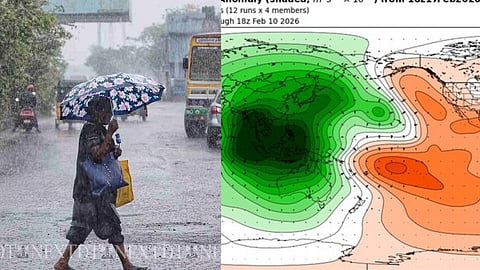
In a recent social media post, Pradeep John said that the Madden–Julian Oscillation (MJO), often referred to as the “King Maker” in tropical weather systems, is finally entering the Indian Ocean region with strong amplitude after remaining largely inactive during the Northeast Monsoon months of November and December.
“Whenever the ‘King Maker’ MJO shows up in the Indian Ocean, it can completely flip the script,” he said.
February is typically part of Tamil Nadu’s dry spell, marking the peak summer build-up phase before the onset of pre-monsoon activity. However, strong MJO phases are known to enhance convection and can trigger unexpected weather developments.
According to Pradeep John, the state could experience out-of-season thunderstorms and even widespread showers during this period. He added that the potential rainfall window extends from the last week of February to the first week of March.
However, he cautioned that these are off-season rains and the interpretation should be taken “with a pinch of salt.” He noted that greater clarity on the event is expected around February 18 or 19.
The Madden–Julian Oscillation (MJO) is an oceanic–atmospheric phenomenon that affects global weather patterns, characterised by an eastward-moving pulse of clouds, rainfall, winds, and pressure near the equator that recurs every 30 to 60 days and is most prominent over the Indian and Pacific Oceans, causing major fluctuations in tropical weather on weekly to monthly timescales.