
- Chennai
- Tamil Nadu
- India
- World
- EntertainmentEntertainment
- Business
- Sports
- Lifestyle
- Technology
- Videos
- Explainers
- Editor's Picks

TIRUCHY: On January 25, 1964, shocked onlookers at the Tiruchy junction railway station witnessed a partially charred youth falling down while screaming ‘Thamizh Vazhga! Hindi Ozhiga!’ (Long live Tamil! Down, down Hindi!). This triggered ‘mozhi por’ (language battle) across the State, in which several youngsters sacrificed their lives for the sake of Tamil.
On January 24, 1964, elders of Keezhapazhuvur (presently in Ariyalur), the then combined Tiruchy district, were puzzled to see A Chinnasamy, who was 27 years old then, distributing sweets to the children and passers-by of his area.
They asked him what he was doing, and Chinnasamy shouted cheerfully, “This day, Hindi is going to die and my Tamil language is going to have eternal life,” and went on distributing sweets.
Subsequently, Chinnasamy, who had completed only Class 3 education, took his bicycle to Periya Pazhur and then Tiruchy where he wrote letters stressing his plan of sacrifice for the language he loved the most. “Oh Tamil, I am going to die for making you live. They have made an amendment to assassinate you and I am going to the war field and perish myself at around 11 am. Seeing this let the people of Tamil Nadu ask why Hindi and for what Hindi,” the letter to his friends said.
“Though Appa mentioned the time as 11 am, he was determined. He went to the Tiruchy junction railway station as early as 4.30 am on January 25, 1964. In no time, he poured petrol over him and lit himself there,” recalled Dravida Selvi, Chinnasamy’s only daughter who was just two years old then. “He had bought 17 litres of petrol to execute his plan. Our relatives found bills in his bag that was hung near a tree before his immolation.”
“Though Appa mentioned the time as 11 am, he was determined. He went to the Tiruchy junction railway station as early as 4.30 am on January 25, 1964. In no time, he poured petrol over him and lit himself there,” recalled Dravida Selvi, Chinnasamy’s only daughter who was just two years old then. “He had bought 17 litres of petrol to execute his plan. Our relatives found bills in his bag that was hung near a tree before his immolation.”
Even while dying, he shouted ‘Thamizh Vazhga! Hindi Ozhiga!’ and fell to his death partially charred. This intensified the ‘mozhi por’, in which many people followed suit, sacrificing their lives for the sake of the language.
Even while dying, he shouted ‘Thamizh Vazhga! Hindi Ozhiga!’ and fell to his death partially charred. This intensified the ‘mozhi por’, in which many people followed suit, sacrificing their lives for the sake of the language.
Chinnasamy opted to commit self-immolation on the eve of Republic day to draw attention of then Chief Minister Bakthavatchalam so that his voice for Tamil would be heard nationwide. His body was taken to the Tiruchy GH, where his family members, including his wife Kamalam and daughter Dravida Selvi visited.
On January 26, his body was taken to Tennur in Tiruchy amid police security and buried there. Thus, the Tamil Martyr’s day is observed in Tamil Nadu on January 25 every year, to mark Chinnasamy’s sacrifice.
Chinnasamy opted to commit self-immolation on the eve of Republic day to draw attention of then Chief Minister Bakthavatchalam so that his voice for Tamil would be heard nationwide
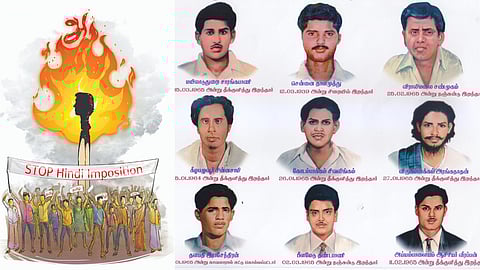
Within a year after his suicide, TN witnessed people dying for the cause. On January 25, 1965, Kodambakkam Sivalingam died by self-immolation. The next day, Virugambakkam Aranganathan died in the same way, followed by Keeranur Muthu who died by consuming poison on February 4, Udayampatti (Karur) Sathyamangalam Muthu on February 18, Peelamedu (Coimbatore) Thandapani on March 2 and Poonthottam (Mayiladuthurai) Sarangapani on March 15.
“These suicides had a greater impact among the student community that year, who began massive agitations across TN. Since January 26 was a holiday, students of University of Madras went on a one-day strike the previous day. Students of Annamalai University too joined the protests. In those days, there were only these 2 universities in TN,” said VN Somasundaram (90), Tamil activist and coordinator, Tiruchy district Tamil Organisations.
Somasundaram recalled that the protests were supported by students of both universities gradually attracted school students too, who, thereafter mobilised the protests against Hindi imposition all over Tamil Nadu. “Interestingly, all the shops were closed in support of the agitation,” he stated.
On January 27, the largest mass protest was held against Hindi imposition. “There were over 50,000 people who marched into Madras City (Chennai), including students and some general public. The marches were peaceful,” Somasundaram said.
After these protests, students from Madurai and Coimbatore cities organised a series of protests including the peace marches that were led by the then student leaders like Elakkuvanar, Sriravasan, Jayaprakasam and Inquilab. “The peaceful demonstrations turned bloody at the end in Sivaganga in which Sivagangai Rajendran, a student of Annamalai University, died in police firing. Some members of a certain political party attacked students with aruval (machete). Tamil blood was spilled again in the protest against Hindi imposition. Many towns and cities in Tamil Nadu had witnessed a similar situation,” he explained.
There were several unwanted incidents faced by the student community in those days. “For instance, the students’ march was stopped in Pollachi at gun point. Even paramilitary forces were brought in to get the situation under control but the government’s efforts failed. Protests continued in which many students lost their lives,” Somasundaram said.