
- Chennai
- Tamil Nadu
- India
- World
- EntertainmentEntertainment
- Business
- Sports
- Lifestyle
- Technology
- Videos
- Explainers
- Editor's Picks

CHENNAI: The first season of the Keeladi excavations officially began on 2 March 2015. Like all ASI excavations, it started with a small ceremony. The ASI team gathered around the mound. A coconut was cracked open, and its water poured over the excavation tools: a knife, a small brush, and a mattock.
Sonai, an 85-year-old landowner, led the ceremony as the village elder. Balu and Vedachalam were there too. Balu had a good relationship with many of the landowners, who were either his or his wife’s former students. Both he and his wife had worked as teachers at the Keeladi Government School.
The team had already contoured the landscape to determine which parts were naturally elevated and which were man-made. They had walked across the Keeladi mound, recording the site’s surface features. Using theodolites, a yellow instrument mounted on a stand, they measured the elevations of various points on the ground.
At Silaiman Station, across the highway from the mound, the mean sea level indicator showed 115 metres. Madurai stood 10 to 20 metres higher, which made sense for a city that had been inhabited for so long.
With these markers noted, the team measured the areas surrounding the mound. Its elevation was higher than that of Silaiman, ranging from 118 to 120 metres. This suggested that man-made structures lay buried below the coconut trees. The ground had likely risen over time due to natural riverine deposits. The Vaigai River had flowed closer to the mound 2,000 years ago than it does today; now it runs roughly 2 kilometres away.
Scientists discovered that habitation along the Vaigai’s banks occurred in stages. There were traces of settlements dating back to microlithic times, when humans used tools made of small stones, and multiple groups with varied customs coexisted.
Floods caused the river to shift course, which may have marooned, buried, or destroyed ancient habitation sites, forcing people to abandon older settlements and move to newer ones. One theory suggested that these ancient societies relied on the floodplains for sustenance but lacked the knowledge to cope with extreme climatic events.
Later research confirmed that Keeladi had experienced a period of drought. Samples taken from each layer of the trench walls revealed diatoms, a microalgae that thrive in the presence of water. The anatomy of these diatoms revealed the nature of the water.
In Keeladi’s case, they pointed to a parched environment. Elsewhere, the discovery of spouted pots suggested the water had been stored for daily use, another sign of dry conditions.
In total, the Keeladi archaeological mound spanned approximately 110 acres. Locally, the mound had many names. It was called Pallichandai Thidal, meaning a ‘mound or elevated place at Pallichandai’. It was also known as mettu punjai or an elevated agricultural land, or vadakku thidal, a mound situated north of the village. It may have been part of an even larger mound, stretching as far as the Keeladi village, a kilometre away, where the team had stopped for tea and met Maharaja a year earlier. It might even have extended up to Nathar’s village of Pallichandai Pudur. But these villages could not be excavated. They faced the same problem as Madurai: people could not be displaced from their homes for the sake of archaeology.
For the first season, the ASI team selected three plots of land, including Silar Moideen’s, from whose property a wall of bricks had been discovered during the exploration phase. The other plots belonged to Balu’s students, Chandran and Dileep Khan. On Sonai’s land, the team pitched the ASI campsite, where they would stay for the duration of the dig, with a fully functioning kitchen.
Moideen’s land became Locality 1, on the eastern edge of the mound. Wheeler’s ghost seemed to hover over the site as the team laid out trenches according to the Wheeler Method. Forty-three quadrants were excavated here with the help of villagers-turned-labourers. They scooped up mud, carried it on their heads, and piled it in small hills at the edge of each trench.
The team meticulously cut into the ground, 10 centimetres at a time. This careful approach was the essence of archaeology, completely unlike the way the Public Works Department dug up India’s cities, using machines to lay sewer and water lines. Here, everything was done carefully by hand.
Unfortunately, no new structures were visible on Moideen’s land. The ASI team could not locate the extensions to the wall they had first seen during their explorations, but they did find several varieties of pottery. Black-and-red ware poured out of the ground. At the edge of the site, a ‘Pottery Yard’ was set up to document all the potsherds in small, square-shaped grids for further study.
From a distance, the heaps looked like tiny pyramids. The pottery offered insights into the commerce and social relations that existed between the harbours and inland areas of ancient South India.
Black-and-red ware, as well as coarse red ware, was found at all Early Historic sites in Tamil Nadu. The coarse red ware was a dull ware made of impure clay mixed with sand particles and grass. Its surface was rough, unevenly fired, and shaped into wide-mouthed storage vessels, large and small pots, dishes, and bowls.
There was also local imitation of red polished ware, a high-quality, lustrous ceramic of Mediterranean origin, introduced to the region via Roman seafarers. Clearly, the area formed part of a complex commercial network across the Indian Ocean in antiquity.
The dig, like a regular office job, ran from 9 a.m. to 5.30 p.m. The labourers lined up for a roll call before walking to the site to sweep fallen leaves or roll up tarps. On some mornings, Balu came to the ASI camp from his residence in Silaiman village, across the highway, bringing fresh produce, mangoes, sapotas, guavas, and limes from his small garden. The epigraphist Vedachalam often brought long, juicy drumsticks.
They would join the team for meals rich in carbohydrates and protein to support the heavy lifting that was archaeological work – pongal, idli, kanji, sometimes vadai, and weekly non-vegetarian fare. Amarnath often requested pazhaya soru kanji, a porridge made from leftover steamed rice soaked in water and left overnight in a clay pot.
Every day, the two assistant archaeologists, Rajesh and Veeraraghavan, along with two site supervisors, woke up at 5 a.m. to hold up bedsheets, shirts, and trousers over the trenches to diffuse the morning light and photograph the site with the material evidence intact. Afterwards, the objects would be moved to storage so the trench could be dug further.
The photos had to be taken within a half-hour window in the morning and evening, when the light was just right. Diffused light was necessary to capture the trenches and artefacts accurately, without the blemish of artificial light, allowing for a clearer view of the site. A scale was placed near each artefact to provide reference for its size and proportion. Amarnath was a strict supervisor, often rejecting a photograph and halting work in the quadrant until the next day if the picture was not perfect. To him, archaeology was ‘recorded destruction’ – since moving an object from where it was found could be seen as destroying the original site.
Everything had to be carefully recorded. If a picture was rejected, it meant that Rajesh and Veeraraghavan had to get up even earlier the next morning to capture the perfect shot.
After breakfast each day, Amarnath began his rounds of the site. Around him, labourers cleaned the area and sifted through the mud to find small and large artefacts. Generally, the lead archaeologist’s work tapers off after the initial discovery; the juniors and labourers take over, doing the actual digging.
Much of archaeology depended on the skill and diligence of these labourers, who over time became adept at cutting precise sections for trenches or unearthing the smallest artefacts. During my travels, I met many people who took immense pleasure in their discoveries.
At an archaeological site in southern Tamil Nadu, a woman labourer would jump up every time an urn she had found was mentioned. ‘I found it!’ she would yell, proudly. At Keeladi, the team found something exciting almost every day. Sometimes, mistakes happened, like a pot being chipped accidentally, in which case, time was spent correcting the error by making detailed drawings and carefully recording the artefact.
That first season ran for six months, till 30 September 2015. Archaeological excavations typically occurred in seasons largely determined by the climate. In Tamil Nadu, the season ran from January to September, before the onset of the northeast monsoons. By August that year, the team had already sent a second proposal to Delhi, requesting permission to continue excavations at Keeladi.
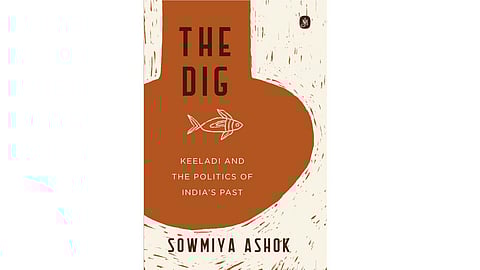
Extracted from The Dig: Keeladi and the Politics of India’s Past by Sowmiya Ashok, published by Hachette India/John Murray India.