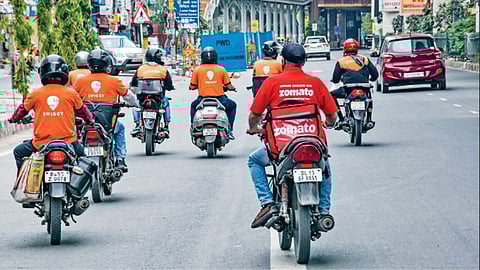

CHENNAI: The State-run welfare system for gig workers is struggling to gain traction as enrolment remains low even after nearly two years since its launch, with officials blaming aggregator non-cooperation and uncertainty over the evolving Union framework.
Since the launch of the Tamil Nadu Platform-based Gig Workers Welfare Board by the chief minister, only 23,740 workers have registered across the State, even as trade unions estimate the gig workforce at 80,000 to one lakh, including over 10,000 in Chennai. At the union level too, enrolment remains limited, with only about 5,500 workers from Tamil Nadu registered on the e-Shram portal, according to a recent reply by the Union Labour Ministry in the Rajya Sabha.
Officials in the Labour Department say aggregators not sharing workforce data remains the biggest hurdle, affecting workers' ability to access benefits. "They do not recognise gig workers as employees and have largely been unresponsive in sharing data. Without it, large-scale enrolment is not possible," a senior official said, while also noting low awareness among workers. Officials added that aggregators maintain gig workers are "floating" and may leave anytime, and therefore companies are not obliged to maintain detailed records.
Trade unions contest this. CITU national vice president A Soundararajan said most delivery workers work long hours and the sector has created steady demand. "Companies are shedding their responsibility despite depending on a regular workforce," he said. Beyond data gaps, uncertainty over the future legal framework remains another concern.
The Union government's Code on Social Security, which creates a national framework for gig worker welfare including accident, health, maternity and old-age benefits, is still being operationalised, with funding structure and implementation rules yet to fully stabilise.
The State welfare board, however, is operational. It provides Rs 1 lakh assistance for accident-related disability and Rs 30,000 for natural death, apart from a monthly pension for members who continue enrolment until 60. The State has also distributed around 2,000 subsidised e-scooters to beneficiaries, according to the Labour Department. Despite these measures, enrolment has remained slow.
"When the union finalises the legal mechanisms, it could supersede some of our existing benefits," the senior official said. Labour Department officials added that with union mechanisms still evolving, aggregator lobbying at the national level has weakened the State's efforts to obtain workforce data.
Tamil Nadu has historically implemented welfare through multiple statutory boards under its 1982 law for manual workers. The State has notified draft rules for three labour codes, but draft rules under the Social Security Code are yet to be framed due to concerns over how the Union framework may affect its existing welfare structure.
With enrolment stagnant, data access blocked and policy direction still unclear, a large section of gig workers in Tamil Nadu continues to remain outside the welfare net, despite being eligible for benefits.