
- Chennai
- Tamil Nadu
- India
- World
- EntertainmentEntertainment
- Business
- Sports
- Lifestyle
- Technology
- Videos
- Explainers
- Editor's Picks
CHENNAI: I was surprised and honoured, says Thenmozhi Soundararajan, as she is feted with the Tamil Nadu Government’s Vaikom Award for social justice. “It is like coming home in many ways,” she begins. Her parents moved to the United States from Coimbatore after facing severe discrimination. The first doctor in his community, from the outskirts of Coimbatore, her father decided to emigrate abroad after enduring numerous caste-based atrocities.
However, things did not improve. As Dr BR Ambedkar stated, South Asians carry their caste with them wherever they go, making caste discrimination a global issue. Thenmozhi grew up witnessing the various forms of inequality her family faced. Inspired by Periyar, Ambedkar, Iyothee Thass, Ayyankali, Savitribai Phule and Jyotiba Phule, and recognising that justice requires action, the Dalit activist decided to highlight her story of caste, her experiences, and those of many survivors and organisations.
“I have faced tremendous violence for mobilising people on this issue and making it visible. Receiving the Vaikom Award is deeply meaningful to me, and I accept this on behalf of all the Dalit women leaders I have had the privilege of working with. I also wish to thank my parents for raising me in the anti-caste tradition of Tamil Nadu, and all the incredible leaders in the Equality Labs,” she says. Founded in 2015, Equality Labs works to end caste discrimination and other forms of oppression, within the south Asian diaspora.
She sheds light on how caste discrimination persists in other countries, sharing, “We still have untouchability here in the US. There are certain temples in Tristate and California, where Dalit bahujans are restricted from entering. Not only traditional injustices, even algorithmically, atrocities continue. It is in my blood to stop this.”
As a technologist, Thenmozhi has been a leading advocate for tech justice. She works to create discussions around caste bias in technology, illuminating how caste operates within supply chains, algorithms, and employment practices of tech companies. Through her advocacy and research with other leaders at Equality Labs, she has worked to ensure caste is recognised as a protected category on major social media platforms.
“In Equality Labs, we fight caste in every domain. I live near Silicon Valley. When we examine closely, all our people face severe discrimination, like caste slurs and sexual harassment in the tech industry. A product created in a biased workspace is always biased. And this movement is crucial because today’s algorithmic biases shape tomorrow’s possibilities. In simple words, it is almost like Manusmriti 2.o,” she explains.
The multi-faceted activist credits Black, Latino, and indigenous technologists for highlighting that online tools are not neutral. “Change begins with conversations. In many ways, we need to examine the political economy of tech, understand where we can empower ourselves to instigate change. Thanks to our consistent efforts, many tech firms have now added caste as a category for hate speech moderation, which is a significant victory,” she adds.
Talking about her role models, Thenmozhi affirms that there is no shame in drawing inspiration from leaders in the anti-caste movement. “Ayyankali and Periyar didn’t ask for dignity — they claimed it. They fought for this space with every beat of their hearts. Periyar’s stand for women’s rights and the Vaikom movement for access are truly inspiring. Iyothee Thass was the first prominent Dalit Buddhist organiser in India. He had no tolerance for British or Brahminical ideologies. Essentially, we have numerous anti-caste movements from the past to learn from. To see intersectionality, if we want to eradicate caste and gender-based violence, patriarchy must end,” Thenmozhi notes.
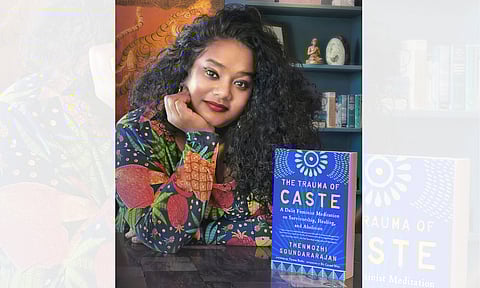
As an author, her award-winning book, Trauma of Caste, guides readers on a journey of truth-telling, abolition, and healing. It was the first book by a Dalit author to win the Adult Non-Fiction Honour at the 2024 Asian/Pacific American Awards for Literature (APAAL). When political struggles feel overwhelming, she turns to creativity for refuge or resistance. Citing Persian poet Rumi, Thenmozhi says his works belong to a time of war and violence, yet his poems encouraged people to reconnect with life. “Similarly, many cannot fight for freedom because they cannot envisage being free. Imagination is a wonderful playground where outcomes can be shaped and visualised.”
According to Thenmozhi, the voice of Dalit women is resonating on global stages, breaking free from the restraints imposed on women from the dominant caste. “We broke the post-colonial frameworks that were established by feminists from the dominant caste. This paved the way for Dalit feminists to find their voices worldwide,” she says.
The history of the subcontinent is one of revolution and counter-revolution. “I believe we are in a period of profound democratic regression. But we have the advantage of unprecedented connections with caste-oppressed people across the world. Now, the challenge is to translate the vision of anti-caste politics into nation-building. Furthermore, it is vital to acknowledge the grief, pain, struggle, and how discrimination has impacted one’s body, mind, and spirit. We have numerous books and laws to combat casteism. Yet it persists, why?” she questions.
That’s why it is essential to bring these conversations to the privileged and make them question their dehumanising behaviour. “Asking this is not easy because no one wants to face the crimes within their family line.” In moments of frustration, Thenmozhi’s thoughts of her carrying a multi-generational legacy help to shift focus and sustain the fight. “It’s like I am part of a whole lineage of people who fought for freedom, and each of us bears a piece,” she states. Thenmozhi envisions a world freed from caste, as Begumpura, imagined by the 15th-century poet Ravidas in his poem. “It is a utopian city, free from sorrow. Similarly, if caste is abolished, people will no longer feel fear. We will be open and expansive. A society free of caste-based discrimination and violence will pave the way for humans to treat each other, the earth, and other species better.”
Before concluding, Thenmozhi shares a few meaningful words for her fellow thozhars (comrades). “We must never give up the fight for dignity. No matter how much it costs or the grief we bear, we never know when our battle for dignity will open the door for thousands to follow. We should never allow anyone to steal our courage because our ancestors stand behind us, whispering to be strong!”