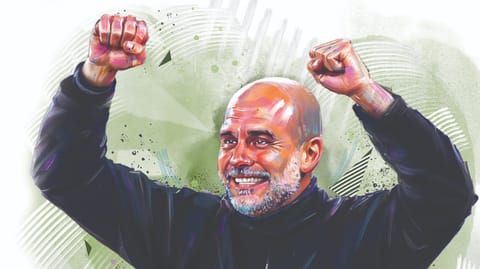

CHENNAI: Just outside the Etihad Stadium, there’s a huge mural of Guardiola, with an accompanying text that reads ‘A perfectionist? That’s part of my job’.
10 years ago when Guardiola took on the English challenge, and joined Manchester City, many believed that English football will humble him, and expose his brand of football. On the day of his unveiling, when asked about the challenge, Guardiola’s first words were: ‘Not bad’.
When he joined the blue side of Manchester, the club had four Premier League titles, five FA Cup trophies, and just one European Cup Winners’ Cup in its history. 380 games later, it is sufficient enough to say that Guardiola has more than survived and the 20 trophies that he has won remains a testament for the success at the now-buzzing Etihad stadium.
In the history of football, very few schools of philosophies have survived the test of time, and one prime one being: Cruyffism. Guardiola did not merely inherit Cruyff’s philosophy, he industrialised it. In a physically demanding league as the Premier League, Guardiola hasn’t just adopted Cruyffism but elevated it to a whole new level to birth the Guardiola-ism.
English football had long celebrated chaos, long-balls strategies and vertical football. Guardiola brought about control, and not just transformed the first-division but also seeped his ideologies into the veins of English football, where tiki-taka is now just normal, as stats indicate in a sharp rise to the passing accuracy. While he doesn’t have the same longevity as Sir Alex Ferguson or the panache that Arsene Wenger had, Guardiola-ism now is the heartbeat of modern football.

It has given philosophical birth to teams like Xavi’s Barcelona, Cesc Fabregas’ Como, Mikel Arteta’s Arsenal, Xabi Alonso’s Bayer Leverkusen, Vincent Kompany’s Bayern Munich and much more, transforming football at one instance. Not just managers, Guardiola has really given some of the biggest players, their breakthroughs, be it Leo Messi at Barcelona, signing Thiago at Bayern Munich and now giving a whole host of players their limelight at City.
But Guardiola’s excellence extends beyond just players, records or titles. It was not the domination but the evolution from his team, against differing opponents. While Guardiola’s City team is built upon the same principles as his teams ever did: maintain possessions and pass around in triangles, have man advantage in midfield and drive the ball forward, he found different solutions to different modern-day tactical challenges, including playing vertical in games that demand, with the presence of Erling Haaland at the top, and also relying on a false nine in encounters against teams with deep defensive blocks, across two title-winning campaigns in the league (2020/21 and 21/22).
Most of the work starts from the back, where the goalkeeper was once a centrifugal part of Guardiola’s setup, with his ability to play with his feet to now a system where he has all but converted his defensive midfielder into another defender in transition. Not just that, what the Spaniard’s City teams did very successfully was play an inverted full-back system, and more recently, a position-less system, where every player is involved in every move.
Not too long ago, he made John Stones, a centre-back as a defensive midfielder, a move that helped the Cityzens break their Champions League drought, with a famous win in Istanbul where Stones dominated the game.
While systematically, Guardiola has often transformed leagues wherever he has gone, what he has now done in England deserves a separate applause because he’s constructed a footballing empire, with now City giving some European giants, a nightmare, a thought that was so alien before he joined the club.
Even in his last season at City, Guardiola wasn’t settling for less, he was pushing Arteta’s Arsenal side to the hilt, and when his side won 2-1 against the North London side, there was a real sense of belief that his side could win from anywhere. That’s the kind of run that they have had in English football, they have managed to win from situations that are not normal, they have managed to go on runs from December that the league hasn’t seen in a long time. So much so that even when they trail by ten points by the end of December, deficits rarely felt permanent.
“If we lose, we will still be the best team in the world. But if we win, we will be eternal,” Guardiola’s daughter, Maria shared a message after he announced his exit from the club.
The records are self-explanatory, with the fourth-most wins in Premier League, winning 269 out of 379 games that he has managed, 2.28 points-per-game—the best ppg that Premier League has ever seen, winning 32 games against 33 Premier League sides that he has faced at the club, becoming the first Premier League team to win 100 points in a season, set a record of 106 goals in a single season and all while going on the longest run of consecutive Premier League wins (18).
Statistics alone cannot define Guardiola’s connection with Manchester City. Over the past six years, people leaving the club has been a normalcy, with legendary footballers walking out from that door having established their legacy at the club. The club hasn’t even had a tough time in replacing the departed ones, including when club skipper Ilkay Gundogan walked to Barcelona. But now, for the first time in nearly a decade, they will have the challenge of replacing possibly the ‘greatest manager’ that modern-day football has ever seen, and that’s quite daunting.
“Nothing is eternal. If it was, it would be here. Eternal will be the feeling, the people, the memories and the love that I have for my Manchester City,” starts an emotional Guardiola in his goodbye message for the Cityzens.
“We fought, and we did things our own way. Our way. Hard work comes in many forms, trips to Bournemouth, when we lost the Premier League, you were there. And trips to Istanbul, when you were there too. You won’t know it yet, you are leaving a legacy,” he added.
“So as my time comes to an end, be happy. Oasis are back again. So ladies and gentlemen, thank you for trusting me, thank you for pushing me. Thank you for loving me.”
“Tony Walsh said in his unforgettable poem this is the place. I’m sorry, Tony: this is my place. Noel (Gallagher) … I was right. It has been so f—ing fun. Love you all,” Guardiola ended his goodbye.
While across the road is a mural, City are now building their own tribute for Guardiola, with a statue and the North End stand to renamed as the Pep Guardiola stand. But deep inside, when someone of Sir Alex Ferguson’s stature sends you a voice note, you know that you have made it big time.
As he moves away from City after a decade, it is only fair to say that Josep Guardiola, you may not have been the special One, you will always remain the extraordinary one, from day one.