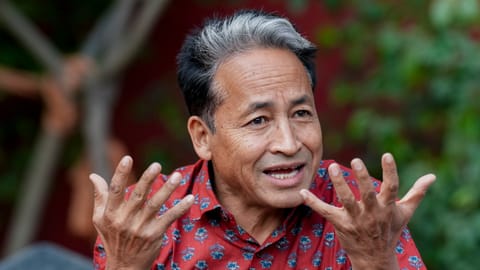

NEW DELHI: The recent talks between Ladakh representatives and the Centre marked a "positive step", activist Sonam Wangchuk said, though he cautioned that trust-building in the region remained incomplete, citing unresolved cases from last year's protests, seizure of personal devices and action against institutions linked to the movement.
In an interview with PTI on Saturday following the latest round of discussions with a Ministry of Home Affairs (MHA) sub-committee, Wangchuk said he noted a shift in his outlook after Thursday's meeting but remains cautious.
"This meeting has made some difference... Otherwise, I was very disappointed," Wangchuk said, reflecting on his earlier experience of being detained this year.
He mentioned that the release order referred to creating "an environment of trust" and moving towards "meaningful and constructive dialogue." However, he alleged that the reality on the ground did not reflect these assurances.
"Nothing was happening on the ground. People were getting divided — Leh and Kargil, Buddhists fighting Buddhists, Muslims fighting Muslims. We felt trust-building was not happening, and meaningful dialogue seemed unlikely," he said.
"Last week was very negative. There was conflict everywhere. I thought Ladakh would become another Manipur; it was heading in that direction," he said.
He said the latest engagement with the Centre has brought some relief. "Both sides have taken a step," he said, referring to the meeting with the Home Ministry sub-committee. Wangchuk stated that optimism would depend on whether the government followed through with concrete measures in the coming weeks.
The activist highlighted several unresolved issues that continue to undermine confidence, including the ongoing seizure of his mobile phone, which was confiscated during protests about eight months ago.
"My mobile phone was taken when I was jailed. It has been more than two months since I was released, and I still do not have it back," he said.
He expressed the impact of this situation, saying, "Without it, I cannot book an Ola, an Uber, or even a plane ticket. Digitally, I have become useless in Digital India." Wangchuk said he had chosen not to replace the phone or recreate his digital access as a matter of principle. "The government has left me half free and kept the other half in jail," he said, referring to the continued seizure of his phone, emails and digital records.
He also mentioned persistent issues surrounding the land lease and FCRA license of the Himalayan Institute of Alternatives, Ladakh (HIAL). "The land of HIAL was cancelled even though we had all the documents. Our FCRA has still not been restored," he said, asserting that scrutiny of the institution's accounts had not revealed wrongdoing.
These developments, Wangchuk argued, had led him to question the reasons behind his release. "The question arises -- was I released out of sympathy or because of the Supreme Court's intervention?" he asked.
While acknowledging the latest progress in talks, Wangchuk said he would judge the Centre's intent by its actions over the next few weeks. "Now, I would like to see in the next one or two weeks whether they correct these things or not," he said.
For Wangchuk, the most significant trust deficit is not about personal grievances but rather cases arising from the September 24 protests in Ladakh.
He raised concerns over criminal charges against protesters and deaths linked to the movement. "The biggest thing is what happened on September 24. So many people were injured, some died... many were charged. Will those cases be withdrawn? Only then will there be trust," he said.
He expressed hope that the change in tone during the latest meeting would extend to decisions concerning pending cases, compensation and institutional issues. "We hope they correct all these things," Wangchuk said.
His remarks come after representatives of the Leh Apex Body and Kargil Democratic Alliance held talks with the MHA sub-committee on constitutional safeguards, democratic powers and governance arrangements for Ladakh.
The two prominent civil society groups from Ladakh have been jointly demanding statehood for Ladakh, constitutional safeguards for land and jobs, and greater democratic powers since Ladakh became a Union Territory without a legislature in 2019.
In a joint statement after the sub-committee meeting on Thursday, both groups indicated they reached an "in-principle understanding" with the Government of India on restoring democracy in Ladakh and providing constitutional safeguards similar to those in Nagaland, Sikkim, and Mizoram under Article 371.