
- Chennai
- Tamil Nadu
- India
- World
- EntertainmentEntertainment
- Business
- Sports
- Lifestyle
- Technology
- Videos
- Explainers
- Editor's Picks

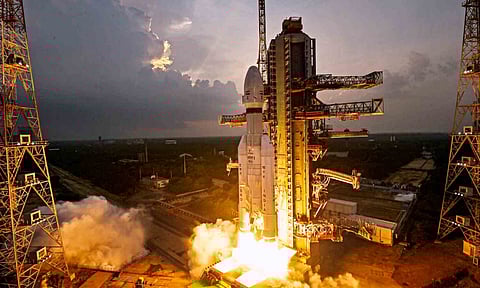
CHENNAI: India’s space programme has achieved a historic milestone with the successful launch of its heaviest-ever satellite, CMS-03, using the powerful LVM-3 rocket, nicknamed ‘Baahubali’. The Indian Space Research Organisation (ISRO) launched the 4,410 kg satellite from Sriharikota, placing it into a Geosynchronous Transfer Orbit (GTO).
The CMS-03 satellite is a multi-band communications satellite that will monitor India’s maritime and land areas for the Indian Navy over the next 15 years. One of its channels will also support the private telecommunications company, OneWeb. The LVM-3 rocket, a key vehicle for India’s future Gaganyaan human spaceflight mission, is now established as a highly reliable launch system with a 100% success rate.
Speaking after Sunday’s launch, ISRO Director V Narayanan said, "LVM-3 with a 100% success rate is fast becoming India’s most reliable rocket".
This launch marks a significant strategic achievement for India. A decade ago, the nation lacked the capability to launch such heavy satellites and was dependent on foreign agencies, like that of France, for such services. This mission, however, was conducted entirely independently. A senior ISRO scientist revealed that the Prime Minister’s Office specifically mandated an indigenous launch to prevent any potential compromise of sensitive Indian Navy data, especially given the growing Chinese influence in the Indian Ocean region.
Furthermore, the mission showcased advanced technical prowess. To position the satellite in its final geostationary orbit 30,000 km from Earth, scientists used the Indian-made C-25 cryogenic engine in a complex manoeuver, switching it off and on again in space for the first time.
The success also has an international dimension, as OneWeb had initially approached Russia for the launch, which was turned down. However, India’s assurance of capability subsequently led to an agreement. Buoyed by this success, Indian scientists are now focusing on developing even more powerful cryogenic engines capable of launching satellites weighing up to eight tonnes.