
Chennai
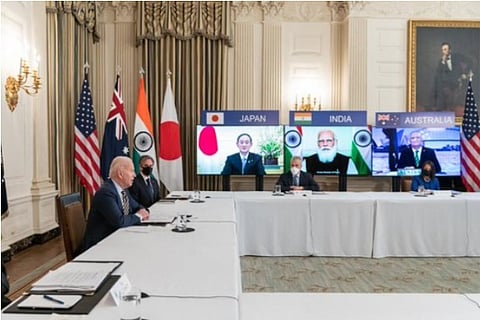
First, India has clearly shrugged off its reservations in engaging substantially with Quad, essentially, a strategic partnership to counter commonly perceived threats in the Indo-Pacific region – read, from China. New Delhi, which was extremely reluctant to anger Beijing and preferred a half-hearted engagement with Quad, has shed its reticence in the face of Chinese aggression last year in the Galwan Valley and its rapidly expanding footprint in the South Asian region. Secondly, all doubts of whether US commitment to Quad would be watered down by President Joe Biden has been set to rest. His administration has signalled very clearly over the last few months that, in this respect at least, there will be no change in the policy that his predecessor Donald Trump forcefully pursued.
The considerable amount of time and attention devoted to cooperation on vaccines to combat COVID-19 was no surprise, given that the meeting was held in the shadow of the pandemic. There is no denying that the initiative to roll out a billion vaccines for the Indo-Pacific region is both extremely significant and impressive. But with Quad, given the compulsions for its formation, it is essential to look beyond cooperation on such things as climate change and new technologies, for which working committees have been set up. Beijing at least has no doubts about the larger purpose of this grouping, having issued a statement that it is more important to enhance mutual understanding than forming closed ‘cliques” and “undermining the interests of any third party.”
But it is China’s increasing assertiveness in the Indo-Pacific region, which borders on belligerence in the South China Sea, which has generated a lot of apprehension among leading global powers and has consolidated efforts such as the Quad. The idea that it has sovereignty over all of the South China Sea is something that has raised tensions in the region and alarmed countries such as Taiwan, Vietnam and Malaysia. China’s forceful push to be the dominant power in the Asian region is a result of its vastly increased economic might, which has led countries around the world to be dependent on it.
And as far as Quad goes, here lies the rub. The four countries in this strategic partnership may have good reason to be worried about China’s growing hegemony, but they are all – to one degree or another – dependent on China’s economic engine to power their own. Australia is the most telling example, a country that exports more than 30 per cent of its products to China. This is the contradiction that Quad will find most difficult to resolve. In a globally enmeshed economy, it is difficult to separate the economic from the political, the strategic, or those that concern human rights and values.
Visit news.dtnext.in to explore our interactive epaper!
Download the DT Next app for more exciting features!
Click here for iOS
Click here for Android