
- Chennai
- Tamil Nadu
- India
- World
- EntertainmentEntertainment
- Business
- Sports
- Lifestyle
- Technology
- Videos
- Explainers
- Editor's Picks
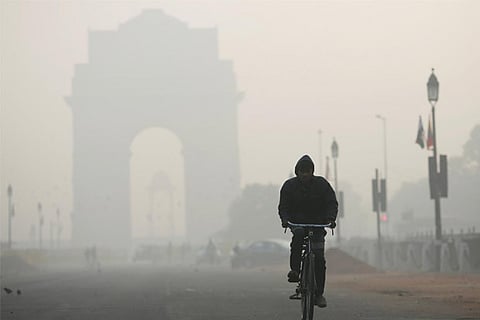
NEW DELHI: Cold wave conditions prevailed over the national capital for the third consecutive day on Tuesday as temperatures dipped further and are likely to persist over the next day, the India Meteorological Department (IMD) said.
The IMD said that Delhi recorded a maximum temperature of 21.6 degrees Celsius on Tuesday, which was 1.7 degrees above normal, while the minimum temperature settled at 3.0 degrees Celsius, plunging 4.4 notches below the seasonal average.
According to the weather department, the minimum temperature of around 3 degrees Celsius recorded at several stations made it the coldest January morning in the national capital in three years. Delhi had last recorded a lower minimum temperature of 1.4 degrees Celsius on January 16, 2023.
Station-wise data recorded at 5.30 pm showed that Safdarjung Observatory, the city's principal weather station, recorded a maximum temperature of 21.6 degrees Celsius.
Lodhi Road logged the highest maximum at 22.0 degrees Celsius, while Ayanagar recorded 21.9 degrees Celsius. Ridge recorded a maximum temperature of 21.4 degrees Celsius, and Palam reported a relatively lower maximum of 19.2 degrees Celsius.
Minimum temperatures remained sharply below normal across the city. Safdarjung recorded a minimum temperature of 3.0 degrees Celsius, which was 4.4 degrees below normal. Palam logged a minimum of 4.0 degrees Celsius, 3.3 notches below normal, while Lodhi Road recorded 3.0 degrees Celsius, three notches below the seasonal average.
Ridge recorded a low of 4.4 degrees Celsius, 3.7 notches below normal, and Ayanagar reported a minimum of 3.2 degrees Celsius, 3.9 notches below normal, the IMD data showed.
On Monday, several stations had also reported minimum temperatures below 4 degrees Celsius, with the IMD noting intense cold wave conditions at isolated places. According to the IMD, cold wave conditions are declared when minimum temperatures fall 4.5 to 6.4 degrees below normal.
The weather department has issued an orange alert for cold wave conditions for Wednesday, with temperatures expected to range between 4 degrees Celsius and 20 degrees Celsius. Cold wave conditions are likely to persist over the national capital, the IMD said.
Meanwhile, Delhi's air quality remained in the 'very poor' category. The city's 24-hour average Air Quality Index (AQI) stood at 360, according to data from the Central Pollution Control Board (CPCB).
In the evening, 30 monitoring stations recorded air quality in the 'very poor' category, while eight stations slipped into the 'severe' category and one station remained in the 'poor' category. Dwarka Sector 8 recorded the worst air quality with an AQI of 438.
According to the CPCB classification, an AQI between 0 and 50 is considered 'good', 51 to 100 ‘satisfactory’, 101 to 200 'moderate', 201 to 300 'poor', 301 to 400 'very poor', and 401 to 500 'severe'.
The Decision Support System (DSS) shows that Delhi's air pollution load is dominated by transport, which contributes 14.3 per cent, followed by Delhi and peripheral industries at 12.1 per cent. Waste burning accounts for 1.2 per cent, construction activities contribute 1.8 per cent, while residential sources add 3.5 per cent to the overall pollution burden.
Among National Capital Region districts, Jhajjar is the largest contributor at 20.5 per cent, followed by Sonipat at 7.83 per cent and Rohtak at 4.9 per cent. Bahadurgarh contributes 2.9 per cent, Ghaziabad 2.1 per cent and Gurgaon accounts for 1.2 per cent.
According to the Air Quality and Weather Services (AQWS), Delhi's air quality is likely to remain in the 'very poor' category from January 14 to January 16. The outlook for the subsequent six days also indicates that air quality is likely to stay in the 'very poor' category.
Delhi's air quality deteriorated to the 'very poor' category with the Air Quality Index (AQI) settling at 337, according to Central Pollution Control Board (CPCB) data.
The CPCB's SAMEER app in the morning showed that 29 monitoring stations recorded air quality in the 'very poor' category, one in 'severe' and nine in 'poor'.
