
- Chennai
- Tamil Nadu
- India
- World
- EntertainmentEntertainment
- Business
- Sports
- Lifestyle
- Technology
- Videos
- Explainers
- Editor's Picks

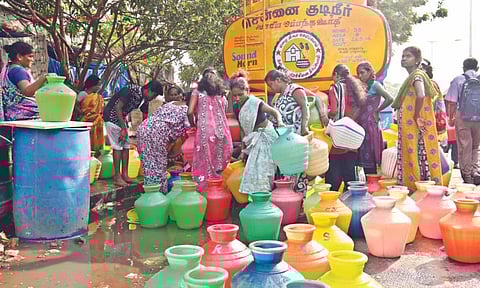
CHENNAI: A study conducted across 14 Indian cities has exposed glaring problems in access to basic urban services, with Chennai emerging as one of the worst cities that lacks access to water supply.
According to a report in The Hindu, the research, covering 31,803 households, found that 17 percent of the city's residents relied on hand pumps while another 14 percent depended on external sources like water tankers.
The findings were part of the Citizenship, Urban Governance and Inequality (CIUG) project led by Brown University Professor Patrick Heller which highlighted how class and caste continue to shape service delivery in urban India.
The study revealed that while cities like Bhavnagar, Kochi and Vadodara excelled in providing quality urban services, Chennai and Mumbai trailed behind significantly. Across India, 43.4 percent of urban households received water for less than two hours a day while 23 percent of households had continuous supply for nearly 23 hours.
While Kochi topped the list in water accessibility, Chennai's erratic supply forced residents to rely on other external arranged. Apart from access, even storage was a challenge, with many households in several cities being forced to store water in buckets owing to unreliable pipelines.
The study also threw light on the fact that sanitation access also varied significantly across cities. While Kochi, Vadodara, Ahmedabad and Delhi served residents effectively, Mumbai households struggled with compromised sanitation.
The study identified housing type as the strongest predictor of access to service compared to other factors. It noted that while caste further deepened the divide, scheduled castes and scheduled tribes experienced significantly poor sanitation compared to other backward classes.
While social dynamics in urban India remain heavily based on caste, Chennai and Kochi stood came across as exceptions by displaying higher inter-caste friendships.
However, trends in the study confirmed that caste still dictated social ties and access to essentials like water and sanitation which reinforced the systemic inequalities in the country.