
- Chennai
- Tamil Nadu
- India
- World
- EntertainmentEntertainment
- Business
- Sports
- Lifestyle
- Technology
- Videos
- Explainers
- Editor's Picks

CHENNAI: Free and fair elections depend on social realities and also on legal frameworks, said Justice Zak Yacoob, arguing that democratic systems struggle when identity begins to influence public policy.
Yacoob, who served on South Africa’s Constitutional Court after being appointed during the presidency of Nelson Mandela and was part of the country’s first Independent Electoral Commission after apartheid, said elections often reflect social realities rather than correct them.
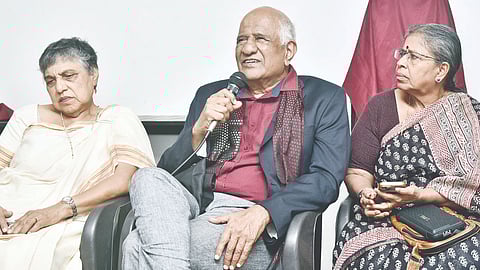
Speaking in Chennai recently at a meeting titled, ‘Free and Fair elections: The South African experience’, convened by Arappoor Iyakkam, Yacoob said powers in northern India often assume that those in the south were beneath, a perception he described as plainly wrong. Referring to tensions between Hindi- and Tamil-speaking populations, he said such prejudices remain part of everyday thinking even though they are rarely expressed openly.
Drawing parallels with South Africa’s own history of racial division, Yacoob pointed out: “Societies may adopt non-discriminatory laws while private beliefs continue to remain unchanged. Once you put race, religion and policy together, you get a very different result – a dangerous mix.”
Referring to India, he noted that people often project non-discriminatory views in public while holding very different opinions in private. These beliefs, shaped by religion, language or identity, quietly influence voting choices and remain largely outside the reach of election law.
“Such prejudices are visible even among university students. Legal safeguards and institutional structures can restrain wrongdoing only to a point. When policing and investigative systems are compromised, those familiar with the system often manage to escape accountability,” he opined.
Yacoob also spoke about South Africa’s proportional representation system, noting that while it enables broader representation, it weakens the direct link between voters and elected representatives. “At the same time,” he cautioned, “constituency-based systems in divided societies risk reinforcing social segregation, making it difficult to balance representation with accountability.”
The event was attended by human rights activists Sudha Ramalingam, V Suresh, law students and other civil society members.