
- Chennai
- Tamil Nadu
- India
- World
- EntertainmentEntertainment
- Business
- Sports
- Lifestyle
- Technology
- Videos
- Explainers
- Editor's Picks

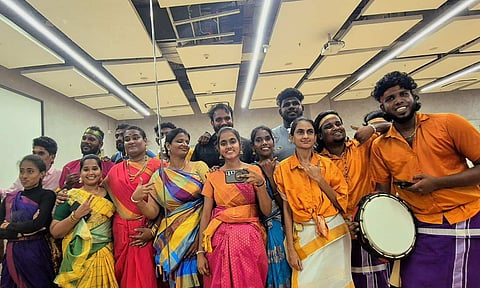
CHENNAI: In the corner of Anna Nagar Tower park we could hear music and laughter, as the Kuyar Kalai Kuzhu is going about their weekly practice while other visitors are doing their routine. The Kuzhu, founded by Lokesh Ranganathan and Marakka, teaches the Tamil folk arts, like Karagattam, Oyilattam, and Parai Aattam, to queer people and women for free.
The Kuzhu serves dual purpose-- to empower through art, and reclaim and re-popularise Tamil folk arts that have been sidelined. “Society outcasts people who tend to perform arts; they scrutinise them more cruelly than it does to those who are regular artistes (dancers who practise western or free-style). They tend to brand such people as koothadi and demean them,” says Lokesh, a corporate employee by day, who wishes to change how the folk arts and queer people are perceived in society.
“Art is a weapon one can use to express themself and helps them carve a niche. And, I wanted to empower the queer community with the same. This art form will help them to come out of their shell, and also perhaps help them earn a livelihood,” says Lokesh. While there exists multiple inhibitions for them to start the classes and form a team, the reception from the community and public has been welcoming, and because it is free of cost, many children are open to learning, as people just want to learn the art forms.
The crew is also attempting to break the gendered notion of these art forms, as Karagattam, while seen as a feminine art form, the Parai is said to belong to men. Sharan Jayaram, a non-conforming psychologist and queer activist part of the Kuzhu, believes they are actively breaking this gendered notion of these arts with their performances. “Parai attam is seen as a masculine art, where women are being refrained from performing . And so is Silambam. However, we have many women taking up the Parai because this is a non-judgmental space. When we perform, we are telling society that these arts have no gender, and so do we.” The Kuzhu has now found an audience, and it has been liberating. “Queer people are repeatedly denied spaces because of our gender identity. We are ridiculed for being too feminine at times, and we are constantly moral-policed. We now have a stage, where we can perform the way without being judged; there is no degree of how feminine and masculine we have to be. Not only can we express, but we also earn out of it. When we are received with cheers and applause, it turns out to be healing,” adds Sharan.
The Kuzhu is building an empowering, safe space for gender minorities. “It is not easy to mingle in a predominantly heterosexual space, and that is why this space came into existence, exclusive for the queer people, a step towards creating a space, a safe space”, says Marakka, a transwoman Tamizh teacher and co-founder of the Kuzhu. “Our goal is to use our talent to express ourselves while also earning from the same. We wish to equip the community with something that would help them secure themselves. We envision being hired for performances at events,and secure the queer community financially”. They performed their first professional performance for an automobile company recently, marking their first paid performance.