
- Chennai
- Tamil Nadu
- India
- World
- EntertainmentEntertainment
- Business
- Sports
- Lifestyle
- Technology
- Videos
- Explainers
- Editor's Picks
CHENNAI: For the next-generation maritime traffic management solution, Paradip port at Odisha will soon have the first-of-its-kind advanced Artificial Intelligence (AI) driven Vessel Traffic Services (VTS) system, which is developed indigenously by Indian Institute of Technology, Madras (IIT-M) and National Technology Centre for Ports Waterways and Coasts (NTCPWC).
PL Haranadh, chairman of Paradip Port, Odisha, told DT Next, “Since the port retained its top position in cargo handling (150 Million Metric Tonnes – MMT), and is expected to increase 300 MMT next year, VTS had to be developed for handling perfect cargo process in future.”
Explaining about the ongoing projects in the port, he claimed that Paradip was also moving towards 100% mechanisation to enhance productivity, reduce turnaround time and strengthen sustainability. “The port is positioning itself as the green hydrogen hub of Eastern India with a MoU worth Rs 1.5 lakh crore signed for green hydrogen and e-methanol projects,” he added. “The port is expected to achieve green port status within the next five months supported by renewable energy initiatives including a 10 MW solar power plant and plantation of over 1 million trees.”
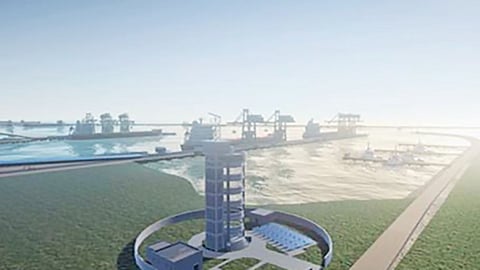
The tower to install the VTS system is under construction, and is expected to be completed in a few months. Sources from IIT-M said that the VTS system would be housed at the port’s upcoming modern VTS signal station upon completion of its construction. The core VTS functional module will be a fully integrated suite covering all vessel traffic service functions, including real-time vessel monitoring, traffic organisation, navigational assistance, incident management, and decision support for safe and efficient maritime operations.
Prof K Murali, head, NTCPWC, IIT-M explained, “The 3D VTS is an advanced module providing complete 3-D environmental and situational awareness, enabling operators to visualise vessel movements, navigational constraints, and surrounding marine conditions for enhanced traffic monitoring and risk assessment.”
An AI-driven digital assistant will be the operator-centric digital assistant that’s powered by IoT and AI, offering automated voice alerts, anomaly detection (oil spill, noise and dust), predictive channel movements, and interactive reporting to support faster decision-making and reduced operator workload.
