
- Chennai
- Tamil Nadu
- India
- World
- EntertainmentEntertainment
- Business
- Sports
- Lifestyle
- Technology
- Videos
- Explainers
- Editor's Picks
Almost a decade or two ago, at dawn, we would wake up to the chirping of sparrows outside our homes. Drifting through a pool of nostalgia, we remember how sparrows pecked at kolams made of rice flour, as though they were family members.
Then, without ceremony, they were gone. The city grew louder, yet its mornings felt strangely hollow, as if a small but essential note had dropped out of tune.
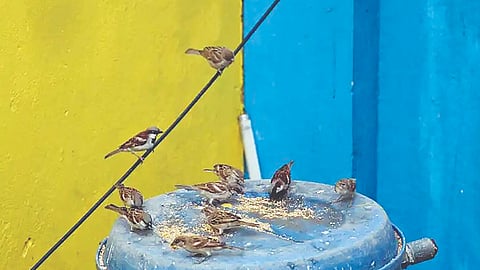
It took Rajinikanth’s 2.0 to make many of us realise that our beloved bird had vanished from our lives. Now, that lost sound is finding its way back. In quiet lanes and crowded neighbourhoods alike, sparrows are returning, perching on balconies, nesting near homes, and reclaiming spaces they once shared effortlessly with people. The reason lies in the consistent efforts of NGOs that are working rigorously to create safe environments for house sparrows in the city.

Koodugal Trust, founded by Ganesan D, has been working steadily towards this cause. Originally from Thaliyur in Krishnagiri district, Ganesan was naturally drawn to birds and nature. In 2014, he decided to educate the public and distribute nest boxes. However, the initial efforts did not yield results.
“I then shifted focus to north Chennai, where sparrows were relatively more visible, and began working closely with school students. We distributed around 13 nest boxes to students at a school in Royapuram, and that was a game-changer,” he says. Students provided feedback on sparrow behaviour and nesting patterns.
To date, Koodugal has distributed nearly 15,000 nest boxes and continues to document changes in sparrow habitats. “With consistent efforts, we have even created a mini sanctuary at a school in north Chennai, where one can spot around 100 to 200 sparrows,” he adds.
Professor Murugavel, associated with the Environmentalists Association of India (EMAI), works towards conserving endangered flora and fauna. “There is no conclusive study proving that mobile phone radiation alone caused the disappearance of sparrows. It could be one of the reasons, but even today, in places like Kodaikanal and Ooty, we can spot a good number of sparrows,” he explains. He adds that sparrows are human-dependent birds that thrive in traditional houses with ample spaces for nesting.
The issue extends beyond shelter to food availability. “Earlier, while sieving paddy, rice husk spillwas age common. Now, with packaged food, there is no spillage, and therefore no food for sparrows,” he notes.
Murugavel also points out that the decline of sparrows has contributed to the rise in pigeon populations. “Pigeons originally lived in small hillocks. Multi-storey buildings resemble such structures, making it easy for them to nest in air-conditioning vents and expand rapidly. Without realising it, humans disrupt the ecological cycle, harming biodiversity,” he says.
According to Ganesan, since 2024, there has been at least a 15 per cent increase in the house sparrow population in the city. “Sparrows prefer trees like lemon or bamboo to escape predators. They begin mating only when they find a secure nesting space,” he explains. Involving students has led to visible behavioural changes. “Children are becoming more responsible, empathetic, and compassionate. Their observational and analytical skills are also improving,” Ganesan adds. He suggests placing at least three to four nest boxes per house. “Due to ecosystem degradation, the lifespan of sparrows has reduced to about five years, compared to nearly 14 years earlier,” he notes.
Murugavel is attempting to reclaim sparrow habitats through EMAI’s initiatives in areas such as Virugambakkam, Red Hills, Ponneri, Chintadripet, and Vyasarpadi. “Deforestation of large trees affects parrots and many other species. Removing a mature tree and replacing it with saplings does not compensate for the loss, as a single tree supports multiple birds and insects.”
Referring to the locust attacks that damaged farmlands in Punjab in 2020, Ganesan highlights the importance of sparrows in maintaining ecological balance. “Sparrows and other birds protect us by controlling insect populations that cause diseases and crop damage. That is how the food cycle works,” he explains.
The sparrow’s return reminds Chennai that coexistence once came naturally, and that with care, memory can still take flight.