
- Chennai
- Tamil Nadu
- India
- World
- EntertainmentEntertainment
- Business
- Sports
- Lifestyle
- Technology
- Videos
- Explainers
- Editor's Picks

CHENNAI: The moment one steps into the NIFT campus at Taramani, it feels like one is at a celebration of India’s craft heritage, not just an exhibition. Colours pop from handwoven textiles, folk paintings sit alongside metal crafts, and the air carries the quiet rhythm of stories shaped by hand and time.
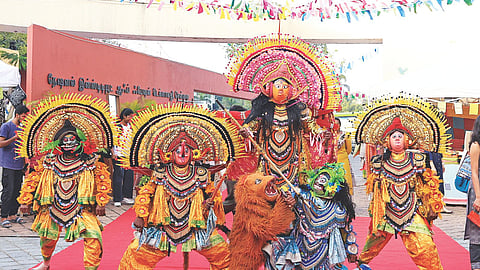
The Dastkari Haat Crafts Bazaar, organised by the Dastkari Haat Samiti, brings together master artisans from across the country, showcasing traditional arts ranging from Kalamkari, Pattachitra, to Gond paintings. Adding to the experience are the Chhau dance from West Bengal and authentic Rajasthani delicacies, turning the space into a cultural junction.
Jaya Jaitly, founder of Dastkari Haat Samiti, believes the strength of the foundation lies in keeping craftspeople at the centre. “When customers see the making and hear the story directly, they are deeply impressed by the uniqueness of non-mechanised, non-standardised products that reflect our culture,” she said.
Rejecting the idea of craft as static heritage, Jaitly argues that tradition must evolve to survive. “Heritage is not like a monument. Skills, food, language and the performing arts must mix, merge and contemporise,” she said, adding, “Everything traditional needs rejuvenation, while retaining its core and origins.”
Project head Charu Verma describes Dastkari Haat as a 40-year-old movement rather than just an exhibition. “We first came to Chennai in 2006 with Kalakshetra and continued till 2016. The passion of the artisans to return brought us back again. The response in Chennai has always been overwhelming. It remains one of our best cities,” Charu said.
Summing up the emotional pull of the exhibit, classical dancer and choreographer Leela Samson said, “The spirit here catches my eye. I can’t stop smiling.” She elaborated that crafts give her a deep sense of inner joy and pride. “As a dancer, I see lines, movement and choreography in these crafts. This is something uniquely Indian, you won’t see this anywhere else in the world.”
For NIFT students like Harini, who is a part of the organising committee, the event is also a learning ground. She noted that it was a privilege to be a part of the event from scratch and called it an opportunity to understand handloom, craft and culture beyond classrooms.
Vijay Soni, a Sanjhi artist from Mathura, says the paper-cutting craft has been part of his family for five generations. “I started learning this when I was in Class 7. It was our family’s livelihood, so from a young age I knew how to draw and how to cut paper,” he said. Explaining the process, he said, “Sanjhi needs a lot of concentration and patience. The detailing is done only with specially made scissors.”
Parveen, who works with women artisans from the border regions of Bikaner, said her work focuses on sustaining traditional embroidery practices. “Over 200 women are working with us. They use only handloom fabric made in Bikaner and do the embroidery completely by hand, without frames or tracing,” she said.
Anne and Navid, from Switzerland, were keen to explore locally made art during their stay in India. “We love art and enjoy making things ourselves, so we wanted to see handmade crafts and buy something meaningful to take back home,” Anne said. “When you talk to the people who make these things, you understand the time, energy, and thought behind each piece. That connection is what makes handmade items more special than store-bought ones,” Navid added.
Visiting Dastkari Haat has become a habit over the years for city resident Meera Krishnan Murthi. “I first walk through the entire bazaar to see the variety and the people behind the crafts,” she said. Having purchased a dress, she added, “These crafts are our heritage. Supporting them is important because this is what keeps them alive.”