
- Chennai
- Tamil Nadu
- India
- World
- EntertainmentEntertainment
- Business
- Sports
- Lifestyle
- Technology
- Videos
- Explainers
- Editor's Picks
Much has been written about the recently inaugurated Victoria Memorial Hall that stands majestically in line with three other beautiful buildings on Poonamallee High Road the Ripon Building, the Central Railway Station and the building that houses the General Manager of the Southern Railways.
The history and beauty of this impressive edifice, and what transpired inside its hallowed hall in the past, have been well chronicled in various write-ups that appeared in different dailies and magazines when the hall was opened for public visits and exhibitions.
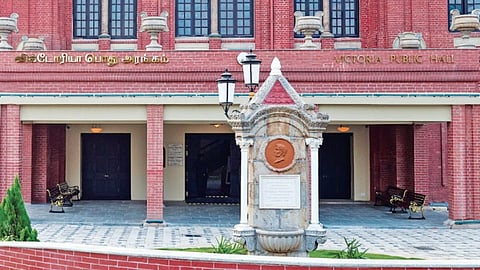
What failed to get mentioned in the various articles is the reference to the memorial plaque with the well-relieved image and inscription that stands in front of the hall, commemorating the services of a British civilian in Madras by the name Charles Trevelyan.
There was a fountain of sprouting water in the forecourt of Victoria Hall before its renovation, with a plaque sporting a carved image of Charles Trevelyan, thanking him for services rendered, which was left uncared for while refurbishing was under way.
After seeing the sad fate of colonial statues that were kept at the entrance of George Gate in front of Government Estate and the one that stood royally adjacent to the Flower Bazaar Police Station, one felt that the plaque and the fountain at Victoria Hall would meet a similarly dismal end.
The one at the entrance of George Gate was later spotted broken and bound with paste at the rear of the Government Museum in Egmore, and the other at Flower Bazaar, though mercifully not displaced, was kept demeaningly out of easy sight by recently constructed commercial vending boxes.
The refurbisher of Victoria Hall has been kind to the image of Charles Trevelyan.
He has not consigned this replica and panegyric plaque to dust. He has reinstalled them in the front yard of the hall. One must be thankful for this grace and small mercy, as these days, whatever is colonial — whether law, statutes, statues, or names of roads, institutions or cities, historical or folkloric, relevant or irrelevant is often altered in attempts to decolonise ourselves.
Who is this Charles Trevelyan, whose bas-relief is fixed at the forecourt of the hall now, and what is his contribution to Madras? Charles Trevelyan (1807-1886) was the brother-in-law of the famous Lord Thomas Babington Macaulay, who wrote the monumental and now controversial Minutes on Education in India, championing English in preference to Eastern education.
He was an English civil servant and colonial officer from 1826 who worked in different places in India, including rural Tamil Nadu in stations such as Dindigul, and later rose to become the Governor of Madras in 1859 and, much later, Indian Finance Minister between 1862 and 1865.
His name is found engraved on the board that bears the names of officers who held charge as Sub-Collector of Dindigul in the Sub-Collector’s Office, as well as in the conference hall of the Chief Secretary in Chennai.
He was known for his famine administration in the State and was a strong advocate of the principle of laissez-faire, holding that there was no room for famine relief by the administration and considering famines a natural phenomenon that should resolve through mobility and market forces. He was a no-dole officer, an incongruity in modern times. Though he kept himself away from relief measures and doles, he planned railways and waterways for the movement of grains to mitigate famine miseries from places of abundance.
He continued this thesis of laissez-faire even in Britain when he was posted between 1845 and 1852 to handle the Irish famine and was severely criticised for his firm faith in market forces and mobility of food grains instead of government relief. As an administrator of Madras, he planned railways and waterways in and around Madras, though he did not physically execute them.
He ordered the allotment of the water basin of the River Cooum to install and expand railways, on which the present Central Railway is located. Hence, a few called the basin north of Central Station the Trevelyan Basin, though, over time, the attribute has been forgotten.
The curiosity to probe the past and the contribution of Charles Trevelyan was provoked in me by a reference to another Trevelyan, George Macaulay Trevelyan, grandson of Charles Trevelyan, professor of history at Trinity College, Cambridge, and great-grandson of Macaulay, who wrote the monumental Social History of England, which was prescribed as a textbook for me at Madras University for BA in the 1960s.
The Social History of England by Trevelyan is reputed to be the first departure from traditional history writing, cataloguing kings and queens.
I was thrilled to see the name Trevelyan on the roll board of officers both in Dindigul, where I served as Assistant Superintendent of Police, and later in Chennai, when I served in senior capacities in the police department.
AX Alexander, DGP (retd), headed the Tamil Nadu Police in 2005-06
A restored memorial at Victoria Hall rekindles debate on colonial legacy while revisiting Charles Trevelyan’s administrative imprint on Madras
